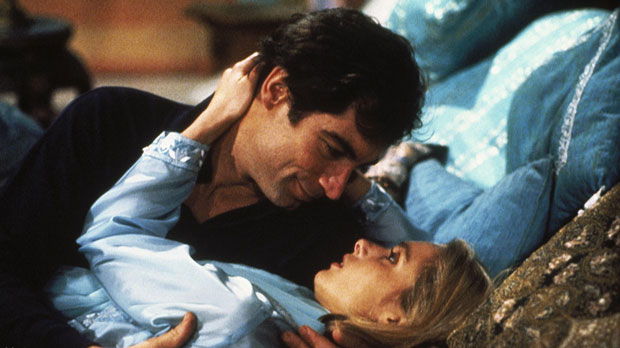
 The Living Daylights (1987) United Artists/Action-Adventure RT: 130 minutes Rated PG (violence, suggestive content, brief nudity, language, drug material) Director: John Glen Screenplay: Richard Maibaum and Michael G. Wilson Music: John Barry Cinematography: Alec Mills Release date: July 31, 1987 (US) Cast: Timothy Dalton. Maryam d’Abo, Jeroen Krabbe, Joe Don Baker, John Rhys-Davies, Art Malik, Andreas Wisniewski, Thomas Wheatley, Desmond Llewelyn, Robert Brown, Geoffrey Keen, Walter Gotell, Caroline Bliss, John Terry, Virginia Hey, John Bowe, Julie T. Wallace. Box Office: $51.1M (US) Theme Song: “The Living Daylights” by a-ha
Rating: ***
As we bid goodbye to Roger Moore with heavy heart, we welcome Timothy Dalton (The Lion in Winter) with cautious optimism. He takes over the role of James Bond in The Living Daylights, a decent entry in the series celebrating its 25th anniversary in ’87. It wasn’t easy getting used to a new face on a familiar character, but I understood the mentality behind it. The series was due for an infusion of fresh blood in order to attract younger audiences. It was time for a few updates including younger actors and a tweaking of John Barry’s score. Thankfully, the producers had the good sense to keep Desmond Llewelyn on as Q. It wouldn’t be a proper Bond movie without his nifty gadgets.
For his first assignment, the new Bond is assigned the task of aiding the defection of KGB General Koskov (Krabbe, The Fugitive) in exchange for crucial information about the state of affairs in the USSR. The plan is to pick him up during intermission at a concert in Bratislava. During the getaway, Bond disables a female sniper, orchestra cellist Kara Milovy (d’Abo, Xtro), by shooting the rifle from her hands. This is where Bond deviates from bureaucratic op leader Saunders’ (Wheatley, Where Angels Fear to Tread) plan by sending Koskov across the border via the Trans-Siberian Pipeline.
It’s during his debriefing that Koskov informs British Secret Service that new KGB head Pushkin (Davies, Raiders of the Lost Ark) has revived the old Soviet policy of Smiert Spionam (“Death to Spies”) and needs to be taken out. Moments after Bond departs the safe house, the general is seemingly abducted by men presumably working for Pushkin. Assuming the KGB head is also responsible for the murder of another 00 agent in the movie’s pre-credit sequence, M orders Bond to Tangiers to kill him.
It should come as no surprise that things aren’t as they seem. Are they ever in a James Bond movie? It turns out the defection was staged and the supposed sniper is actually Koskov’s girlfriend. It’s somehow connected to an arrangement he has with illegal arms dealer Brad Whitaker (Baker, Walking Tall). 007 takes advantage of the naive girl’s allegiance to Koskov in trying to track him down.
Directed by Bond vet John Glen, The Living Daylights doesn’t really hold together when you stop to think about it. It’s especially convoluted this time with a plot that also involves Afghan rebels and a huge shipment of opium. The resulting confusion causes the viewer to notice some pretty major plot holes. For one thing, why would the British government even consider eliminating a high-profile political figure on the word of one untrustworthy individual? What do they have to gain? Also, why attract the attention of a government agency to an operation involving drugs and illegal arms? I know, you’re not usually supposed to ask such questions of a James Bond film. However, it’s justifiable in this case since the makers appear to be taking things seriously, too seriously if you ask me.
The main question regarding The Living Daylights is this: does Dalton cut it as James Bond or not? The answer is yes and no, mostly no. He takes himself and the character way too seriously. Playing a character as preposterous as 007 requires a lighter touch, a knowing attitude and the ability to wink at the audience while performing death-defying stunts. Sean Connery understood that, so did Roger Moore. Dalton doesn’t. That’s not to say he’s a terrible Bond. He gets some of it right. Like his predecessors, he’s suave, stylish and sophisticated. He displays cool authority in non-action scenes like the debriefing where he quietly glares in cold skepticism at Koskov as he weaves his tale. HOWEVER, he’s a much different Bond from the one we’ve gotten to know in the past quarter-century. Intense and borderline self-loathing, he lacks a sense of humor. His one-liners all sound forced. All in all, it’s a rocky beginning to Dalton’s brief reign in the Bond universe.
Bond movies typically sink or swim on the strength of their villains. In The Living Daylights, you get three for the price of one. Only one of them makes any real impression. It’s not Koskov; he’s too mild to pose any real threat. It’s not Whitaker either. He’s an oafish military man wannabe who spends most of his screen time playing with toy soldiers. The true villain in The Living Daylights is Koskov’s American alt-rock loving henchman Necros (Wisniewski, Die Hard). He’s a cold-blooded killer who takes out one target with booby-trapped automatic doors. His climactic mid-air fight with Bond on a plane is cool. BTW, it comes complete with a bomb set to go off unless Bond gets to it in time to disarm it.
What about the Bond girl in The Living Daylights? The term “utterly forgettable” applies here. Simply put, d’Abo isn’t up to the task. Although definitely attractive, she lacks the charisma and pluck one expects from a Bond lovely. She doesn’t even get to sleep with Bond who goes celibate in this outing, yet another unfortunate by-product of the AIDS era. Her character Kara isn’t all that interesting until the end when she leads an army of Afghan freedom fighters into battle against the bad guys. Aside from that and her instrument, she leaves no lasting impression whatsoever.
Despite its flaws, I enjoyed The Living Daylights well enough. It has a few cool action scenes including one where Bond and Kara use her cello case as a toboggan in order to evade their pursuers. The stunt work is spot-on as usual. John Barry’s score gets an update with electronic rhythm tracks added to the orchestral music. Unfortunately, the theme song by Norwegian synth-pop band a-ha is instantly forgettable. No matter, The Living Daylights is still entertaining even with its confused narrative and too self-serious tone.