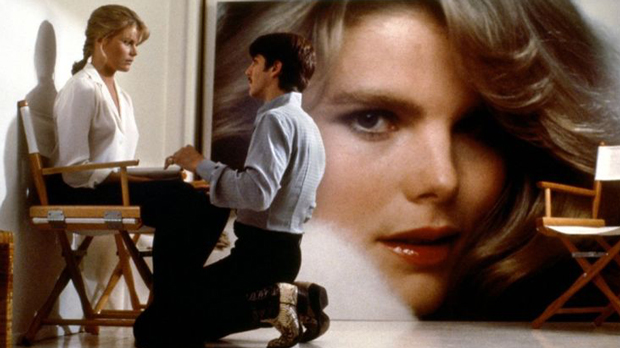
 Star 80 (1983) The Ladd Company/Drama RT: 103 minutes Rated R (language, strong violence, rape, emotional abuse, nudity, sexual content, thematic elements) Director: Bob Fosse Screenplay: Bob Fosse and Teresa Carpenter Music: Ralph Burns Cinematography: Sven Nykvist Release date: February 3, 1984 (US) Cast: Mariel Hemingway, Eric Roberts, Cliff Robertson, Carroll Baker, Roger Rees, David Clennon, Josh Mostel, Lisa Gordon. Box Office: $6.4M (US)
Rating: ****
Star 80 tells the tragic, true-life story of Dorothy Stratten (Hemingway, Personal Best), the 1980 Playboy Playmate of the Year who was murdered by her disturbed estranged husband Paul Snider (Roberts, The Pope of Greenwich Village) before he turned the shotgun on himself. Be warned, this is one dark movie. That it opens by showing us the messy aftermath of the horrific crime speaks to the director’s dark intentions. There is no joy to be derived from Stratten’s few triumphs because we already know her career will be tragically cut short on August 14, 1980. Bob Fosse (Lenny, All That Jazz) doesn’t hold back in any way. He points his camera and gives the viewer an uncompromising look at a young, naive girl continuously exploited by a sick man who claims to love her.
Part drama and part documentary, Star 80 recounts the doomed relationship between Dorothy and Snider starting with their first meeting when she was just a high school senior working at a Dairy Queen in Vancouver. He’s a real piece of work, this guy. He’s one of those slick, smooth-talking, macho types who prowled discotheques in the late 70s. With his expensive wardrobe and well-sculpted physique, Paul Snider was every girl’s Prince Charming. Snider immediately puts the moves on Dorothy and it isn’t long before they’re romantically involved over the objections of her mother (Baker, Kindergarten Cop) who correctly pegs Snider as a hustler who wants something from her naïve, innocent daughter.
One night, Snider convinces Dorothy to allow him to photograph her in the nude. He tells her she’s beautiful. She argues that her hands and feet are too big. He arranges for a professional photographer to create a portfolio that he sends to Playboy after forging Mom’s signature on the consent form. They’re brought to the attention of publisher Hugh Hefner (Robertson, Charly) who invites her to his mansion in L.A. where she finds instant success as Playmate of the Month (August ’79).
Snider joins Dorothy in L.A. later and makes an immediate bad impression on her new friends and business associates. Insecure as ever, he suggests they elope to Vegas. This, of course, will ultimately be a fatal mistake. As Dorothy matures, she starts to outgrow Paul. He senses her pulling away from him which makes him grow more unhinged. Love becomes obsession. The tighter he tries to hold on to her, the more he pushes her away. She leaves him and moves in with another man, director Aram Nicholas (Rees, Cheers), a stand-in for Dorothy’s real-life lover Peter Bogdanovich. He can’t bear the thought of her with someone else. If he can’t have her, nobody will. It’s a sad end to a life that had barely begun (she was only 20).
Star 80 never once flinches from its subject matter. In his final work, Fosse presents it all in a matter-of-fact kind of way. He was notorious for showing the dark side of fame in his films. Look no further than his adaption of Cabaret, the biopic Lenny and the largely autobiographical All That Jazz. Fosse was the natural choice to tell Dorothy’s story, a dark chapter in show biz history. It may be one of the darkest. He makes no attempt to soften the impact either. He hits you head-on in showing how the young girl’s naivety made her vulnerable to Snider’s superficial charms and self-serving actions.
As Snider, Eric Roberts delivers one of the most terrifying performances I’ve ever witnessed. He depicts Snider as a sleazy, parasitic, paranoid, jealous control freak who expects his wife to support his lavish lifestyle. He says he’s a “promoter” (i.e. he provides sexy girls for auto shows), but he comes off more like a pimp. He expects Dorothy to be at his beck and call at all times and cater to his every whim (even when she’s at work). Roberts perfectly captures the essence of a loser who lives for leeching off others. He’s angry at the world because he believes everybody is deliberately trying to keep him down. He can’t stand it when he’s declared persona non gratta at the Playboy mansion. Roberts’ finely nuanced depiction of this creepy individual touches on every layer of his disturbed personality including his capacity for violence. He makes Snider simultaneously evil and pitiable. It’s the actor’s best performance EVER. Another great crime was committed when he wasn’t nominated for an Oscar.
Hemingway is wonderful as the late Dorothy Stratten. Her innate understanding of Dorothy enables her to deliver a most sympathetic performance. Here we have an innocent teenage girl, a babe in the woods really, working the counter and clearing tables at the local Dairy Queen. She doesn’t believe she’s beautiful and can’t understand why this seemingly sophisticated older man is interested in her. Why she has such low self-esteem is a mystery. The fact is she was a gorgeous girl with a sparkling personality. Hemingway brings it all out, especially in scenes where she charms interviewers with her bubbly personality. Who knew it was a mask hiding her emotional pain and anguish? Hemingway’s performance in Star 80 is nothing short of poignant. There’s pathos in almost everything that she does whether it’s posing for Polaroids or playfully roller skating at the Playboy mansion.
As Nicholas/Bogdanovich, Rees is very good. He’s smitten with Dorothy from their first meeting when she shows up at his place to read for his next movie. He tells her it’s not necessary for her to audition. He can’t take his eyes off this exquisite beauty. Robertson delivers a convincing performance as Hugh Hefner, father figure to his “girls”. He takes a special interest in Dorothy. He tries to convince her to leave Snider, who he describes as “a hustler and a pimp”, before he destroys her career with his petty and parasitic ways. He never liked the guy from the start.
Fosse gives Star 80 a documentary-like feel by having his characters speak directly to an off-camera interviewer about Dorothy. It’s a creative conceit that makes the film’s human subject more tangible for the audience. Fosse achieves a level of perfection that most other filmmakers couldn’t even hope to reach. He has a real flair for scene composition; it shows in the scenes set at Paul and Dorothy’s home. Home is supposed to be a warm and safe place, but here it looks cold and threatening, a sign of the violence to come. The depth of Paul’s obsession is expressed in the way he has pictures of her on every wall in the house. There’s one uncomfortable scene where he shows photographs of Dorothy to his housemates while obsessing over the happiness they once shared, alternating between sentimentality and hostility the whole time. Even more uncomfortable is the scene where he literally begs her for another chance. It’s pathetic really. You almost feel sorry for the guy. I said, almost.
Everything in Star 80 comes together so perfectly that it’s almost a pleasure to watch. Again, almost. Make no mistake; it’s a dark and disturbing film. The cinematography by Sven Nykvist alternates between soft-focus and harsh lighting. It’s the perfect blend for this movie as it augments the contrast between Dorothy’s innocence and the reality of her bleak situation. The score by Ralph Burns is haunting, another reminder of the tragedy that overshadows the joy of her instant stardom. As you can tell, Star 80 isn’t for everybody. An examination of a toxic relationship isn’t exactly light fare. It’s an extremely serious film for serious moviegoers. Me, I think it’s positively brilliant. It’s still chilling four decades later.
Why don’t I close with some interesting trivia I found? The climax was shot in the same house where the murder-suicide took place. Hemingway got breast implants specifically for this role. She wanted to embody Stratten on both a physical and psychological level. In real life, Bogdanovich ended up marrying Dorothy’s younger sister Louise in 1988. They divorced in 2001.