 The Irishman (2019) Netflix/Drama RT: 209 minutes Rated R (pervasive language and strong violence) Director: Martin Scorsese Screenplay: Steven Zaillian Music: Robbie Robertson Cinematography: Rodrigo Prieto Release date: November 8, 2019 (Philadelphia, PA) Cast: Robert De Niro, Al Pacino, Joe Pesci, Ray Romano, Bobby Cannavale, Harvey Keitel, Stephen Graham, Kathrine Narducci, Stephanie Kurtzuba, Anna Paquin, Gary Basaraba, Jesse Plemons, Domenick Lombardozzi, Sebastian Maniscalco, Jeremy Luke, Aleksa Palladino, India Ennenga, J.C. MacKenzie, Larry Romano, Jake Hoffman, Patrick Gallo, Barry Primus, Jack Huston. Box Office: $7M (US)/$8M (World)
Rating: *** ½
It would be an oversimplification to refer to Martin Scorsese’s latest Mob-themed drama The Irishman as Oldfellas and I don’t want to do that as it would be doing the film a great injustice. It’s different from anything Scorsese has ever done with one of his gangster dramas. Whereas Goodfellas and Casino are cocaine-fuelled trips through violent gangland territory, The Irishman is more of an elegiac piece with scenes of strong violence. This is especially true in the final half hour, without a doubt one of the finest bits of filmmaking ever to grace the silver screen.
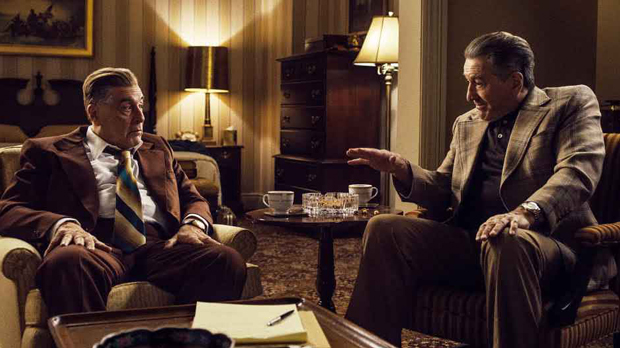
Based on the book I Heard You Paint Houses by Charles Brandt, The Irishman reunites Scorsese with his old friends/players Robert De Niro, Joe Pesci and Harvey Keitel (sadly underused as Philadelphia mob boss Angelo Bruno) in this fact-based account of the life of Frank Sheeran, a union official, hitman and close associate of mob boss Russell Bufalino. He was one of the very few non-Italians who had close links to high-ranking members of the Mafia. De Niro plays Frank who we first meet as an old man in a retirement home. The film opens with a tracking shot (a signature Scorsese move) that glides slowly through the halls to Frank sitting alone in a wheelchair in his room while The Five Satins’ “In the Still of the Night” plays on the soundtrack. He begins to speak immediately establishing his role as narrator of his own story, one that places him in close proximity to several significant moments in American history- e.g. the Anastasia hit, the Bay of Pigs invasion in Cuba, the JFK assassination, etc.- like the Forrest Gump of organized crime.
The Irishman spans Frank’s life beginning with his introduction to crime boss Russell Bufalino (Pesci) who takes a liking to him and starts giving him errands which ultimately include murder. The film’s main focus is Frank’s longtime friendship with labor union leader Jimmy Hoffa (Pacino, The Godfather) who, as you know, famously disappeared in 1975. Frank claims to have killed him on orders from the Mafia after Hoffa became too big of a threat. A road trip to an associate’s wedding in ’75 serves as a pretext for the Hoffa hit as well as the framing device for the movie’s narrative.
The film also touches on Frank’s personal life; specifically, how his “profession” affected his relationship with his family especially his daughter Peggy (Paquin, True Blood), a sensitive type who keeps her father and his associates at arm’s length (except Hoffa with whom she becomes close).
It’s in the final half hour or so when The Irishman shifts gears and Scorsese lets you know what he’s really up to. Frank, now an old man, is alone. Most of the people he knew are dead. His remaining family members don’t see him too much. Feds occasionally show up to ask questions about old unsolved Mob-related cases; Frank remains tight-lipped even though the people they ask about are gone. He knows the end is near so he makes arrangements for his own funeral since he can’t rely on anybody else. His sense of aloneness is best expressed in the scene where he tries to tell a young nurse about his friend Hoffa and she’s never heard of him.
Here’s my take-away. Scorsese has reportedly said that The Irishman will be his last Mob-themed movie. In essence, he’s saying goodbye to a genre that has treated him well. At the same time, it’s a goodbye to a way of life. Old school mobsters are pretty much extinct. It’s a new breed of gangster out there. Scorsese beautifully captures the idea of the passing of time with Frank’s story.
At three and a half hours (with NO intermission), The Irishman is a huge commitment and one well worth making. It’s an outstanding film. It’s not as great as Goodfellas, but it ranks right up there. Its only real flaw is not giving the wives enough to do. As you recall, wives played an important role in both Goodfellas and Casino. Lorraine Bracco’s fiery cuckold and Sharon Stone’s gold-digging drug addict were essential parts of the main characters’ narratives. In The Irishman, the wives of Frank and Russell (played respectively by Stephanie Kurtzuba and Kathrine Narducci) literally take a back seat to their husbands. The most we hear of them is Russell’s wife asking him to stop so the ladies can take a smoke break (they smoke a lot).
Many are critical of the de-aging process used to make the actors look younger in the flashback scenes. Okay, the technology still hasn’t been perfected but it’s come a long way since Rogue One. It doesn’t look as creepy; it’s getting there. Speaking of the actors, all of them are phenomenal in The Irishman. This is definitely one of De Niro’s best performances. His character is enigmatic in that he may very well be a sociopath. Murder is just another day on the job for him. A flashback to his time in WWII shows him executing two German soldiers after making them dig their own grave. He does it without emotion. Is this a sign of things to come? If indeed he is a sociopath, are his feelings of loss over his estrangement from Peggy sincere? We simply don’t know.
Pesci, in his first role in nine years (after 2010’s Love Ranch), is the most restrained he’s ever been in a Scorsese film. His character is nowhere near as volatile as Tommy DeVito (Goodfellas) or Nicky Santoro (Casino). Pacino, in his first film for Scorsese (can you believe they’ve NEVER worked together before?), is good even though it’s basically Al Pacino playing Hoffa as Al Pacino. He shouts nearly all of his dialogue. I guess it’s a good thing Hoffa had a similarly boisterous personality. The three actors work extremely well with each other. The supporting cast, which includes Ray Romano (as lawyer Bill Bufalino), Bobby Cannavale (as mobster Felix “Skinny Razor” DiTullio), Stephen Graham (as Tony Provenzano) and Gary Basaraba (as Teamsters usurper Frank Fitzsimmons), is uncommonly strong.
On the surface, The Irishman is about Frank Sheeran telling his life story. His reliability as a narrator is questionable. Crime historians claim he was prone to exaggerate his importance in pivotal events. Who knows for sure, right? Thematically, The Irishman is a meditation on sin, loss and regret. It’s as contemplative as his religious-themed pictures- e.g. The Last Temptation of Christ, Kundun and Silence. In other words, it’s deep. As usual, Scorsese deftly shifts between eras using voiceover dialogue to make the time-jumps seamless. In short, The Irishman is an excellent film. Although it’s coming to Netflix at the end of the month (November 27 to be exact), I opted to see it at the movies because Scorsese is worth it. I urge you to do the same. Yes, it’s that good!