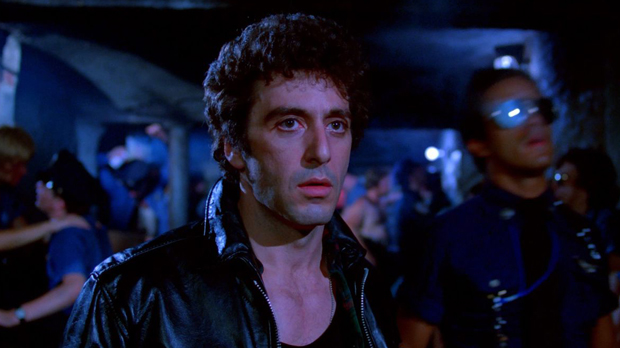
 Cruising (1980) United Artists/Suspense-Thriller RT: 102 minutes Rated R (strong sexual content/references, nudity, graphic violence, language including slurs, drug use, thematic elements) Director: William Friedkin Screenplay: William Friedkin Music: Jack Nitzsche Cinematography: James Contner Release date: February 15, 1980 (US) Cast: Al Pacino, Paul Sorvino, Karen Allen, Richard Cox, Don Scardino, Joe Spinell, Jay Acovone, Randy Jurgensen, Barton Heyman, Gene Davis, Arnaldo Santana, Larry Atlas, Allan Miller, Sonny Grosso, Edward O’Neill, Michael Aronin, James Remar, William Russ, Mike Starr, Steve Inwood, Leo Burmester, Henry Judd Baker, Robert Pope, Keith Prentice, Leland Starnes, Powers Boothe. Box Office: $19.8M (US)
Rating: ** ½
The Al Pacino suspense-thriller Cruising came out when I was in sixth grade. I remember all the controversy surrounding it when it opened nationwide that February. The gay community felt it inaccurately portrayed the leather/S&M subculture and that it would incite violence against gay men. As such, they encouraged their members to interfere with filming by way of disruptive behavior (e.g. making noise, playing loud music and pointing mirrors from nearby rooftops). They also asked all gay-owned businesses to bar cast and crew from their premises. There were massive protests at cinemas showing the film. Now-defunct GCC (General Cinema Corporation), who successfully bid to be the sole exhibitors, refused to show it once they got a look at the finished film, saying it was too shocking and explicit.
I knew there was no point in asking the parentals to let me see Cruising. It would have been an emphatic “HELL NO!” for sure. At 12, I’m not sure I would have wanted anybody to know I saw it for fear of being incorrectly labeled gay. Also, it got really bad reviews. I didn’t hear a single positive thing about it at the time. Then again, I didn’t know a lot of people at 12. I definitely didn’t know any gay people personally (none that I knew of anyway). I only had the reviewers on TV and in print to go on.
I didn’t see Cruising until I rented it on video in spring ’85. It wasn’t a positive viewing experience. I couldn’t put into words what I didn’t like about it at that time. All I know is that it wasn’t a good movie. Now, 40 years later, I can put into words my feelings about this deeply flawed yet fascinating serial killer thriller. First though, let’s talk plot.
Pacino (Serpico, Dog Day Afternoon) plays Steve Burns, an NYC cop asked to go undercover in the gay community to find a vicious serial killer targeting gays. He fits the basic physical description of the other victims. It’s hoped that he will draw out the killer. He’s promised a promotion to detective if he sees the assignment through.
Operating under the alias John Forbes, Steve immerses himself in a world of leather, S&M, sweaty bars and cruising. For those who don’t know, the term “cruising” refers to searching for sexual partners for one-night hook-ups. It’s all alien to him. In an early scene, he commits a major faux pas by keeping a yellow hankie in the wrong pocket*. Steve eventually gets his act together, but it affects his relationship with his girlfriend Nancy (Allen, Raiders of the Lost Ark).
William Friedkin was one of the hottest directors of the early half of the 70s with acclaimed hits The French Connection (1971) and The Exorcist (1973). He also made one of the first mainstream films about gays, The Boys in the Band (1970). He followed up his back-to-back successes with Sorcerer (1977) and The Brink’s Job (1978), both of which bombed at the box office. Friedkin probably hoped Cruising, loosely adapted from the novel by New York Times reporter Gerald Walker, would put him back on top. It didn’t. It did okay financially ($19.8M against an $11M budget), but it fared poorly with critics. For all its ambition, it’s definitely not one of the filmmaker’s finer moments.
How can I put it? Cruising postures and flexes only to turn and run when confronted with questions. It leaves you with more questions than answers when it’s over. It steadfastly refuses to tell you how the protagonist feels about the world he’s sent to investigate. How is he affected by what he sees and experiences? Is he repulsed by it? Intrigued by it? Turned on? Does it make him question his own sexuality? How does he feel about the prejudice against gays displayed by his colleagues? More importantly, how does he feel when it’s directed at him during the brutal interrogation of a suspect? The screenplay is frustratingly vague on many points.
Friedkin fumbles with the storyline as well. As a thriller, Cruising is just okay. It’s reasonably suspenseful. The killings are bloody and brutal. They’re as messy as the narrative. It introduces characters like Steve/John’s neighbor, a struggling playwright named Ted (Scardino, He Knows You’re Alone) in an abusive relationship, only to sideline him. The same goes for the patrolman (Spinell, Maniac) and his partner (Starr, Goodfellas) who rape a couple of transvestites at the beginning of the movie. Friedkin makes out like Spinell is going to be a major character with one of the transvestites (Davis, 10 to Midnight) reporting the incident to Steve’s CO Capt. Edelson (Sorvino, Goodfellas). That too gets dropped. And what about the body parts found floating in the Hudson River? Where do they fit in? That’s never resolved.
Now let’s talk about the ending. It’s a great big WTF. It starts with Steve/John apprehending a guy who’s most likely the killer. He has mental issues. It seems pretty cut and dry, but is it? In the very next scene, Edelson responds to the scene of another murder in the gay community. That too seems obvious; it’s the dead guy’s violent (and MIA) partner. Or is it? That’s where we see Spinell’s character one last time. Edelson remembers his name and gets this look on his face. What’s he thinking? Who knows? Then we get to the final scene involving Steve and his girlfriend. They’re about to have a conversation and the movie just ends, but not before the gf does something weird. I have no idea what to make of any of this. Like I said, WTF. All I know is that it’s these last moments that sink Cruising.
I normally like Pacino and although he does what can here, it’s not much because Friedkin gives him nothing in the way of character development. What do we really know about this guy? He’s a beat cop and has a girlfriend, that’s it. We know nothing of his background. He’s just this undercover cop going against his true nature (does he?) for the sake of finding a killer. Sorvino is okay as the commanding officer. All we know about this guy is his job depends on the case being solved. Allen gets nothing to do as the girlfriend who wants Steve to let her in. The characters (if you can call them that) in Cruising are very one-dimensional.
You have to admire Cruising for going where Hollywood previously refused to go for fear of alienating straight audience. Friedkin pulls you into this dark underworld and lets you see it in all its rawness courtesy of cinematographer James Cortner. It pulls no punches in this area. At the same time, it’s exploitative. After a while, it becomes more of a freak show than a thriller. I can see why the LGBTQ+ community was so pissed. Interestingly, Cruising came out around the same time as the lesbian-themed thriller Windows, another one that generated controversy for being homophobic (it is).
In the end, any power that Cruising might have had is dissipated because of Friedkin’s lack of courage to really go there. It’s disappointingly superficial favoring cheap thrills over bold statements about a taboo subject. That’s too bad; it really could have been something.
* = It means he likes receiving golden showers. Different color hankies signify different kinks.