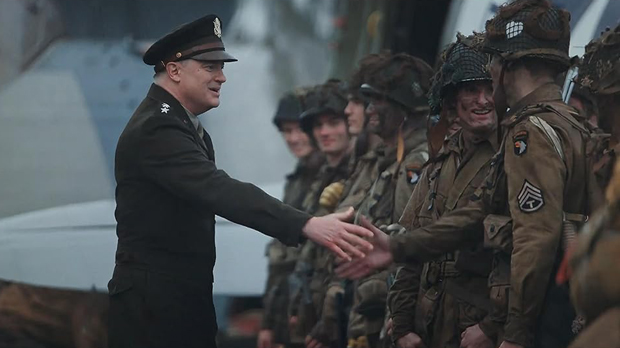
 Pressure (2026) Focus/Drama RT: 100 minutes Rated PG-13 (war violence, bloody images, some strong language) Director: Anthony Maras Screenplay: David Haig and Anthony Maras Music: Volker Bertelmann Cinematography: Jamie D. Ramsay Release date: May 29, 2026 (US) Cast: Andrew Scott, Brendan Fraser, Kerry Condon, Chris Messina, Damian Lewis, Con O’Neill, Alexander Hanson, Robert Portal, Henry Ashton, Tamsin Topolski, Joshua Hill, Jojo Macari.
Rating: ***
To me, the ultimate cinematic depiction of D-Day (June 6, 1944) will always be Steven Spielberg’s Saving Private Ryan (1998). He eschews the derring-do of John Wayne or Sylvester Stallone in favor of bloody realism. It gives the viewer some idea of what it was like to actually be there on Normandy Beach with all the young soldiers that died there. No filmmaker will EVER replicate it.
To his credit, director Anthony Maras (Hotel Mumbai) doesn’t even try to in his D-Day drama Pressure. In fact, he spends very little time on the battlefield. Instead, he focuses on what went down behind the scenes in the days leading up to the invasion. It almost didn’t go down at all. There were complications that no amount of planning could surmount. There’s this little thing called weather. Maybe you’ve heard of it?
Based on the stage play by David Haig (who co-writes this adaptation with Maras), Pressure centers on the relationship between Scottish meteorologist Capt. James Stagg (Scott, 1917) and General Dwight D. Eisenhower (Fraser, The Whale), the architect of Operation Overlord. Eisenhower calls in Stagg to provide a favorable weather forecast just three days prior to D-Day which was originally set to take place on June 5. Unfortunately for Ike and the other SHAEF (Supreme Headquarters Allied Expeditionary Force), the news isn’t good.
After examining the data, Stagg concludes the weather on the proposed day will not be conducive to a military operation. It seems that two storms are headed straight to the area. This means heavy winds, high waves and low visibility. This means ships and planes won’t be able to make it to shore. All of it spells certain failure. Stagg goes on to suggest they postpone it for a couple of weeks. Of course, nobody is pleased about this, least of all Eisenhower who’s still haunted by the failure of Operation Tiger (a rehearsal op of sorts) just six weeks earlier.
Not everybody agrees with Stagg’s analysis. Col. Irving Kirk (Messina, Air), an American meteorologist, has a different take. He believes the weather will be absolutely perfect that day and that Overlord should commence as planned. What he’s not taking into account, according to Stagg, is the unpredictability of English weather. He’s basing his findings on patterns from North Africa, an area of the world with more stable weather conditions.
Stagg and Kirk employ different methods to arrive at their conclusions. The Scotsman relies on meteorological intelligence compiled from different weather stations around the world. He analyzes the data and gives his findings. Kirk, on the other hand, uses analog forecasting based on historical pattern readings. He predicts the weather based on comparable days of the past. But here’s the thing. In 1944, meteorology was primitive compared to today. It was impossible to forecast the weather with any real certainty. Stagg can only say storms are highly likely; he can’t be 100% sure. Kirk, all cockiness and bravado, insists he’s right.
For his part, Eisenhower doesn’t know who to believe. Kirk has always done right by him in the past, but Churchill himself personally recommended Stagg to provide his expertise. There’s a lot riding on the operation. It could (and ultimately did) change the direction of WWII. Everything has to be just right; there is no margin of error. They can’t afford to delay D-Day too long lest the Germans find out what the Allied Forces are planning.
Although it lacks the raw, visceral power of Saving Private Ryan, Pressure is a compelling war drama about the people moving the pieces on the board. The drama isn’t limited to the workplace. There’s a personal component to Stagg’s story. It would be easy to see him as rigid and disagreeable, but that’s not the case. He accepted his current assignment knowing his wife (Topolski, What You Wish For) back home is pregnant and days away from giving birth. Then he gets the news that the hospital she’s in was bombed in an air raid. He has no idea if she’s dead or alive, but he can’t allow it to distract him. He still has an important job to do.
In the role, Scott delivers a powerful performance without being showy. It’s what you might call reserved, a trademark of the British. In an early scene, he shares a tender but not overly emotional goodbye with his wife before leaving. It’s a nice moment in a sober, serious drama. Fraser, an actor whose career is seeing an upswing after his Oscar win for The Whale, turns in a somewhat soulful performance as Eisenhower. There’s definitely something sad behind the future President’s tough-as-nails façade.
Kerry Condon (F1) is also very good as Lt. Kay Summersby, Ike’s private secretary and closest confidante. Any rumors that the two of them were involved in an affair are NOT confirmed here. Messina damn near steals the show as bombastic Kirk, a guy who loves to brag about how he worked with David Selznick on Gone with the Wind.
Pressure looks cheap at times, but there’s only so much you can do with a $30M budget these days. It doesn’t buy what it used to. However, the film isn’t about huge battle scenes and explosions. It’s about something much deeper. It deals with the psychological battlefields that WWII was fought on. Even the greatest military leaders experienced doubt and uncertainty. Experts couldn’t agree on things. Big decisions often came down to the very last minute. That’s where the tension in Pressure lies. It’s fairly cerebral for a so-called war movie. It’s a good companion piece to the Spielberg film.