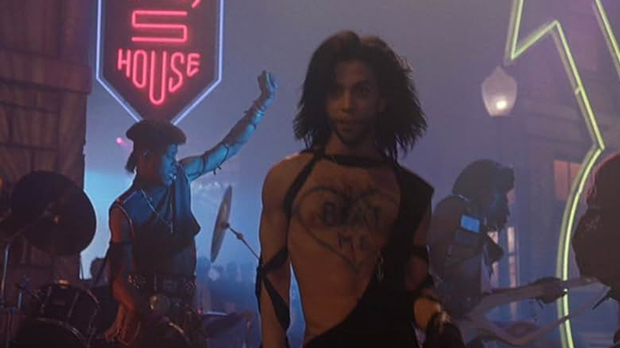
 Graffiti Bridge (1990) Warner Bros./Musical-Drama RT: 91 minutes Rated PG-13 (language, some suggestive material, mild violence) Director: Prince Screenplay: Prince Music: Prince Cinematography: Bill Butler Release date: November 2, 1990 (US) Cast: Prince, Morris Day, Jerome Benton, The Time, Ingrid Chavez, Jill Jones, Mavis Staples, George Clinton, Tevin Campbell, Robin Power, T.C. Ellis. Box Office: $4.5M (US)
Rating: *
Graffiti Bridge isn’t a movie; it’s a psychotic break with a soundtrack.
The above is the most apt description of Graffiti Bridge, a quasi-sequel to Purple Rain, the smash hit musical drama that briefly made a movie star out of funk-rock star Prince. Whereas the 1984 film is set in a recognizable reality, the 1990 follow-up takes place in what looks like a funked-out version of the Neighborhood of Make-Believe except there’s no trolley back to the real world. There is no escape from this weird place. Did anybody try clicking their heels three times while saying “there’s no place like home”?
PLOT? WHAT PLOT? Between the surreal aesthetic and musical performances every few minutes, I didn’t notice much of a story. It would appear to be about the continued rivalry between The Kid (Prince playing a version of himself) and Morris Day (as himself). They’re co-owners of a night club called Glam Slam. Day wants to take over the whole night club scene in the fictional Minneapolis neighborhood of Seven Corners. He wants Kid out because he continues to make music nobody but him likes. It’s all going to come down to a battle of the bands between the two.
Divine intervention arrives in the form of Aura (poet-musician Chavez in her only film role), an angel sent from God to inspire Kid and help de-escalate the increasingly hostile situation with Day. She appears from out of nowhere in a dark alley and takes up residence at a local landmark called Graffiti Bridge. She’s often seen sitting there writing poetry, just waiting for one of the guys to come along and flirt with her.
Besides the main characters, which also include Jerome Benton reprising his role as Day’s right-hand man, the only connection Graffiti Bridge has to its predecessor is Kid writing letters to his now-deceased father. It’s also mentioned that his mother has been institutionalized. In addition, Day’s “girlfriend” Robin (Power) is the daughter of Billy, the owner of the First Avenue club where Kid performed in the first movie. I was yesterday years old when I noticed that last thing.
In case you didn’t know, you’re talking to one of the few people who saw Graffiti Bridge at the cinema. I made a special Monday night trip to a multiplex not accessible by public transportation after 9pm. I could have seen it the night before while I was in the city, but I didn’t feel like staying in town that late. I decided to wait until I felt less tired so I could fully absorb the Prince experience. And believe me, Graffiti Bridge is an experience. And I don’t mean that in a good way. Not only is the Purple One’s worst movie; it’s one of the worst movies of the 90s (or any decade). It’s what I call artistic masturbation. Prince made it to please nobody but himself. It’s a vanity project gone wild. I am shocked the studio let him go through with it. It shows how much clout he had at the time.
Prince wore many hats on Graffiti Bridge. In addition to starring in it, he wrote and directed it. He also composed and performed most of the songs. Unfortunately, not a one of them is memorable. The Purple Rain soundtrack, still one of the best sellers of all time, contained so many great songs- e.g. “When Doves Cry”, “Let’s Go Crazy”, “I Would Die 4 U” and the title track. Morris Day also had a couple of hits, “Jungle Love” and “The Bird” as did Apollonia, “Sex Shooter”. I can’t recall hearing a single song from Graffiti Bridge on the radio. Apparently, the album did pretty well; it charted at number 6 in the US. It also includes tracks by Mavis Staples, Tevin Campbell and The Time (w/Morris Day). None of the songs are actually terrible; they’re just forgettable. I think Prince’s most ardent fans would beg to differ on this point.
Graffiti Bridge contains some really goofy dialogue. Some it sounds like it comes from a fortune cookie. Some of it is just inexplicable. Here are but a few samples:
“Are there really angels, or are they just in our minds? It all comes out in the wash… in time.” (Opening lines)
“You can’t fight fire with fire. When a man screams, you must learn to whisper.”
“It’s just around the corner.” (Repeated throughout)
There’s more, but this should give you an idea of what to expect. The characters speak like nobody from the real world thus making stronger my argument that the movie takes place in some imaginary world far from reality. Geographically, it might be closer to the small town stuck in the 50s time warp in Cool as Ice (the one with Vanilla Ice).
Do I even need to say it? The acting in Graffiti Bridge is terrible. I’m talking all caps B-A-D! Prince is a magnetic performer, but an actor he’s not. The only time he’s ever given something close to a performance is Purple Rain and he was essentially playing himself. Here, in his final theatrical film, he plays an even weirder version of himself. To his credit, he keeps the character drama stuff to a minimum in favor of performing music. It’s the only thing he gets right in this wrong-headed movie.
Day is just as bad if not worse. In the original movie, he was a rival musician with a huge ego. In this one, he’s a crime boss set on taking over the entire club scene in Seven Corners. He sends his gang (played by members of back-up band The Time) to do his bidding. One thing that hasn’t changed is how he treats women. If anything, it got worse. Look no further than the bit where he takes Aura on a date with Jerome in tow (of course). The plan is to get her drunk and take advantage of her when she passes out. Fortunately, Kid activates his super powers and rescues her in the nick of time, leaving the guys confused.
Chavez is nice to look at and has a pleasing voice, but has zero acting ability. She was a last-minute replacement for Kim Basinger who dropped out after she and Prince broke up. Yes, they dated for a while. Reportedly, Sheena Easton, Mayte Garcia and Sheila E. were also considered for the role of Aura before Chavez got the gig. This is her one and only acting credit. Considering what she shows here, and it isn’t much, it’s all for the best.
If Prince is a terrible actor, he’s an even worse filmmaker. Like his character, he makes art for his own gratification. He’s the only one who gets it. Therein lies the paradox. How do you get it when there’s nothing to get? Graffiti Bridge is an empty package with a shiny wrapper. It looks good, but there’s nothing inside. The movie is really nothing more than a series of music videos strung together by something resembling a plot. To be fair, it was originally supposed to be a vehicle for Day and The Time. That is, until Prince got involved and turned it into what it is now. That would explain the disconnect between Kid’s personal story and the plot involving Day’s power grab attempt.
I’ll admit the film’s visual style is unique. A combination of neon lights, dry ice, slo-mo shots and a primary color palette, it’s surreal and dreamlike. One of the visual motifs is a lone white feather floating in the air. Hey, maybe this is where the makers of Forrest Gump got the idea. You think? A lot of Graffiti Bridge was shot on a soundstage which explains the artifice that overtakes the whole project. It’s been described as “avant-purple”, but that’s just a fancy term for artistic masturbation.
Like I said at the onset, Graffiti Bridge is like a psychotic break captured on film. It makes no sense. It’s as far removed from any discernible reality as a Dali painting. How did it get made? How did it get released? How did Prince not become a laughing stock? The world will never know the answers to any of these questions (Prince died in 2016) and maybe we’re better off not knowing. Perhaps we’ll find out in the afterlife.