 The Babe (1992) Universal/Drama RT: 115 minutes Rated PG (language, some sexual situations, alcohol use and drunkenness) Director: Arthur Hiller Screenplay: John Fusco Music: Elmer Bernstein Cinematography: Haskell Wexler Release date: April 17, 1992 (US) Cast: John Goodman, Kelly McGillis, Trini Alvarado, Bruce Boxleitner, Peter Donat, James Cromwell, J.C. Quinn, Joseph Ragno, Richard Tyson, Ralph Marrero, Bob Swan, Bernard Kates, Michael Grady, W. Earl Brown, Elizabeth Greenburg, Ralph Foody. Box Office: $17.5M (US)/$19.9M (World)
Rating: ***
I didn’t see 1948’s The Babe Ruth Story, but it’s considered one of the worst movies ever made. I did see The Babe, the 1992 biopic starring John Goodman (Roseanne) as the baseball great. It didn’t get stellar notices either. It’s flawed, no doubt, but I liked it.
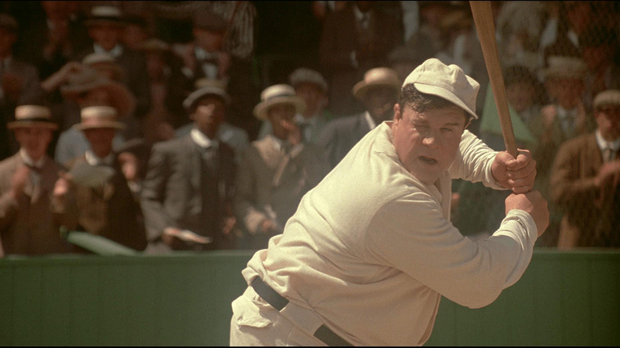
Directed by Arthur Hiller (Outrageous Fortune), The Babe tells the story of Babe Ruth, one of the greatest baseball players to ever grace the diamond. He could hit the ball like nobody else. In his words, he liked to hit home runs. He was a god in the park. Off of it, he was more of a monster. According to the movie, he was a rude, loud, boorish pig who couldn’t control his appetites for booze, women and food. He continuously cheated on his first wife Helen (Alvarado, Little Women). He had an explosive temper, routinely bullying and threatening others. He was like a big kid who always had to have his own way. Say it ain’t so, Bambino.
The Babe follows Ruth from childhood to retirement. He grew up an unwanted child, abandoned by his father at a Catholic-run reform school where he was labeled “incorrigible”. It was there where he first displayed his ability to knock the ball out of the park. It was this gift that got him an early release from the school when Baltimore Orioles manager Jack Dunn (Quinn, Barfly) “adopted” the 19YO to play for his team. He’s quickly sold to the Boston Red Sox and eventually to the New York Yankees. He becomes one of the most popular baseball players of his time, holding the record for most career home runs for several years until Hank Aaron broke it in ’74.
Off the field, Babe was what we now call a train wreck. His wild and reckless ways ended his first marriage and got him suspended more than once. He would eventually remarry to former Ziegfeld Follies star Claire Hodgson (McGillis, The Accused). She calmed him down a bit, but the damage was already done. He was no longer respected by the game he loved so much. It didn’t love him back.
Goodman is a good actor, but he’s completely miscast as young Babe. He was 39 when he filmed The Babe and looks it. He does not pass for a young man. He’s better as older Babe, looking completely tired and worn down by his wild lifestyle. McGillis does quite well as Claire, a more grounded woman who’s been around the block a few times and knows the score. Alvarado is also good as naïve Helen, a classy and educated young lady completely lacking in common sense. Why does she stay with somebody who treats her badly?
Hiller, working from a screenplay by John Fusco (Young Guns I & II), hits all the major bullet points like Babe promising a seriously ill boy two home runs in his next game and calling his shot in the 1932 World Series. It also shows his friendly rivalry with fellow legend Lou Gehrig (McGrady, Hocus Pocus). What he doesn’t do in capture the joy of the game. For some reason, there is no joy in Babe-ville. Quite the opposite, The Babe is depressing as hell. Is Hiller trying to de-mystify baseball or what? Where is the joy that comes from sitting in the bleachers chowing down on hot dogs and peanuts while watching ball field heroes do their thing? Even Babe doesn’t look all that happy. He puts on a good front, but he’s actually a miserable and unpleasant individual. Again, this is according to this movie, but who ever said it was the gospel truth? Biopics are known for taking dramatic license with the facts when they don’t suit the intended narrative.
I will say that The Babe scores when it comes to recreating the time in which it’s set (1902 to 1935 when he quit mid-game). The cars, costumes and interiors all look authentic. As for the depressing tone of the film, I can only surmise that Hiller was going for realism. It’s admirable, I suppose, but that’s not what baseball fans want from a movie about one of their heroes. Why destroy the legend? Like I said, I liked The Babe, but I think a better film could be made about Babe Ruth. It’s been more than 30 years, so maybe another filmmaker would like to take another swing at the Sultan of Swat?