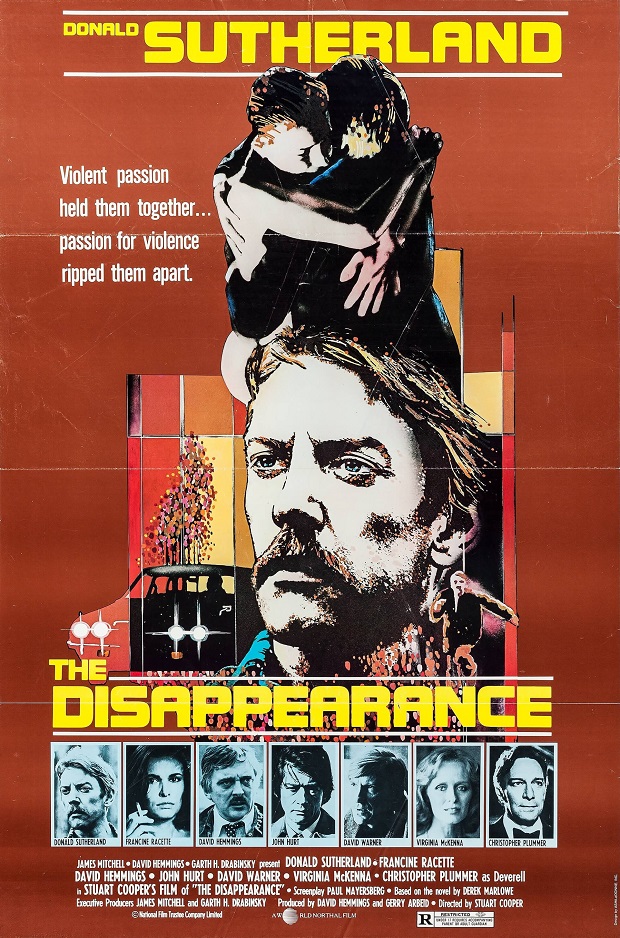
 The Disappearance (1977) World Northal/Suspense-Thriller RT: 91 minutes Rated R (language, violence, nudity, sexual content) Director: Stuart Cooper Screenplay: Paul Mayersberg Music: Robert Farnon Cinematography: John Alcott Release date: September 25, 1981 (US) Cast: Donald Sutherland, Francine Racette, David Hemmings, John Hurt, David Warner, Peter Bowles, Virginia McKenna, Christopher Plummer, Michele Magny, Duane Howard, Robin Sachs. Box Office: N/A
Rating: *** ½
On a 1981 episode of Sneak Previews, Gene Siskel and Roger Ebert ganged up on poor Donald Sutherland, selecting two of his movies as their Dogs of the Week. One of them chose the turgid Alistair MacLean adaptation Bear Island. The other went with The Disappearance, a noir-ish thriller featuring the actor as a hitman looking for his missing wife. The critics saw them as a double feature. I wonder if they flipped a coin to determine who got to trash which movie. I can tell you this. They were dead-on about Bear Island. They were dead wrong about The Disappearance. It’s GREAT!
Directed by Stuart Cooper (Little Malcolm), The Disappearance is a joint British-Canadian production. It was originally released in 1977, but closed after an extremely brief run in cinemas. Audiences reportedly found it slow and confusing with its non-linear narrative. The studio, against the director’s objections, re-edited it in chronological order, cut it down to 81 minutes and tried again. It didn’t do any better. It disappeared again from cinemas and the collective memory of the moviegoing public.
I watched maybe the first 15 minutes of The Disappearance on cable in 1983 before switching it off in boredom. At 15, I wanted more action. That was then; this is now. I’ve wanted to give it another chance for a while now. I had several chances in the 90s as it was available at one of my local video haunts The Movie Company. I always passed it up for something else. I thought I was out of luck until I stumbled across a copy about a week ago. I wasted no time in securing it for a late night viewing. I didn’t know what to expect, especially now that my tastes are more refined (?). It took a minute or two to get the rhythm of this bleak suspense-thriller, but once I did, I was totally into it.
Sutherland (Ordinary People) plays Mallory, a hitman who works for a clandestine outfit called “The Office”. No, it’s not managed by Steve Carell. He comes home after a job to find his wife Celandine (Racette, Four Flies on Grey Velvet) gone, vanished without a trace. Flashbacks reveal a stormy but passionate marriage. Their main point of contention seems to be his career. It could be that she simply left him. Or it could be something worse.
The higher-ups in The Office want Mallory to accept a job in England. They don’t give him too many details including the intended target (or “shy” as it’s called here). It sounds shadier than usual. It could be a set-up. It could also be connected to his wife’s disappearance. He’s unsure, but he takes the job anyway to see where it takes him.
I enjoy many subgenres of film- e.g. spaghetti westerns, 80s slasher horrors, bad American remakes of French comedies, dubbed kung fu flicks, goofy (non-Disney) kiddie matinee movies and anything from Cannon or New World. I also enjoy Canadian tax shelter movies like Rabid (1977), The Silent Partner (1978), City on Fire (1979), Prom Night (1980), Tulips (1981) and Class of 1984 (1982). The Disappearance definitely falls under that category. Filmed (mostly) in Montreal, it has a distinctive Canadian flavor. Cinematographer John Alcott (The Shining) makes excellent use of the snowy, unforgiving wintry landscapes. They’re a perfect match for the cold nature of the characters. The city has a barren, unwelcoming look to it. The apartment building Mallory lives in is anything but warm and homey with its cold, inhospitable design. Even the scenes shot in Suffolk have a gray, ominous look. This is what film noir looks like in daylight.
Sutherland plays a great villain. He was incredible as a murderous German spy in Eye of the Needle (1981). He’s equally great as a cold-blooded killer in The Disappearance. Although his character is technically the hero of the piece, he’s still very much a bad guy. He dispatches his targets with cold, precise efficiency. He remains unreadable throughout, always keeping his guard up when it comes to personal matters. He’s not entirely unfeeling though. He does love his wife and wants to locate her more than anything. Racette, Sutherland’s then-wife, plays Celandine as a complete enigma with dialogue like “One day I leave you, then you’ll understand”. She perfectly captures the character’s tempestuous nature.
Mr. and Mrs. Sutherland are aided by an impressive supporting cast that includes David Warner (TRON), David Hemmings (Blow-Up), John Hurt (The Elephant Man), Peter Bowles (The Offence), Virginia McKenna (Born Free) and Christopher Plummer (The Silent Partner). Plummer is particularly good as a character integral to the plot. He makes a memorable impact despite having a mere four minutes of screen time.
Based on the Derek Marlowe novel Echoes of Celandine, The Disappearance is a well-written, slow-burn suspense-thriller that sneaks up on you. Initially, you might think it’s too slow and going nowhere. You might also be put off by the frequent flashbacks to various points in Mallory and Celandine’s relationship. It provides context for how he’s feeling now that she’s gone. Let me assure you there’s more going on than that. The screenplay by Paul Mayersberg (The Man Who Fell to Earth) doesn’t spell some things out. It assumes intelligence on the part of the audience. He leaves it up to the viewer to figure them out on their own based on subtle hints and nuances. It’s quite brilliant really.
I think I know why Siskel or Ebert (not sure which) chose The Disappearance as their Dog of the Week. They probably saw the recut version. I never saw it, but it sounds to me like it defeats the intention of the filmmaker. He was going for something smart; the studio wanted audience-friendly. This is why films need to be left to the artists who create them. Studios just f*** things up. I’m glad to see The Disappearance is its intended form. It’s a true hidden treasure.