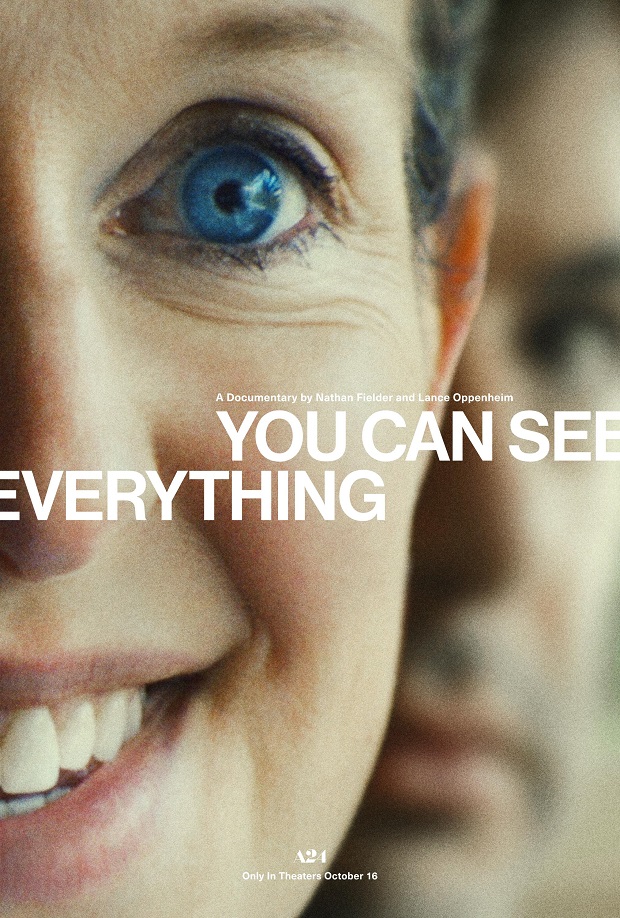
 You Can See Everything (2026) A24/Documentary RT: 174 minutes Rated R (language, some graphic nudity) Director: Nathan Fielder and Lance Oppenheim Screenplay: Nathan Fielder, Lance Oppenheim, Tatiana Bears, Maggie Ambrose and Jack Davis Music: Ari Balouzian Cinematography: David Bolen Release date: October 16, 2026 (US) Cast: Nathan Fielder, Elizabeth Holmes, Billy Evans, Amanda Seyfried, Christopher Abbott, Lance Oppenheim, Phillip Andre Botello, Manik Choksi.
Rating: *** ½
But can you see everything? That’s the main question asked by Nathan Fielder in his meta documentary You Can See Everything. It not only subverts form, it asks us to consider everything he captures on camera about his subject Elizabeth Holmes, the disgraced founder of now-defunct health care outfit Theranos. Is she as innocent as she claims or the greatest manipulator of our time? Are we seeing a performance or the real thing? Once it’s done, you still might not have definitive answers.
So you’ve probably been hearing a lot about the twist in You Can See Everything. I will confirm that it takes a wild turn into unexpected territory about midway through its nearly three-hour run time. It keeps going after Holmes reports to federal prison to begin serving her 11-year sentence for defrauding investors out of hundreds of millions of dollars on a product that never worked. Where it goes, I won’t say. I’ll only tell you that it’ll have you rethinking everything you just saw. It’s really quite brilliant what Fielder and co-director Lance Oppenheim (Primetime) do here.
Ostensibly, You Can See Everything is about Elizabeth Holmes. Fielder and his small crew are invited to stay with Holmes and her husband Billy Evans for the final days leading up to her reporting to a prison camp in Bryan, TX to start serving her time. Right off the bat, something is off about their dynamic. You can see it when Billy takes over making breakfast because Elizabeth isn’t whisking the eggs the right way. Turns out he’s a bit of a control freak. He displays his need to control everything, including the narrative, throughout.
As Fielder talks to Holmes, it’s clear she has issues. Through his interactions with his subject, we learn that she believes she’s done nothing wrong. He tries to explain it to her using cold, hard facts, but she just doesn’t seem to get it. At one point, he tries to illustrate his point by showing her the famous Abbott and Costello routine “Who’s on First?” She doesn’t get why it’s funny or how it pertains to her as it relates to her handling of the situation.
During his time with Holmes, Fielder understands her less and less. He ends up with more questions than answers mainly because she can’t or won’t give him any straight answers. Billy isn’t much better. He typically dodges questions with non-answers all of which affirm his complete dominance over his wife. It’s an interesting dichotomy, a supposedly powerful woman under the influence of a domineering man. I’m sure feminists might have a few things to say on the matter.
Amanda Seyfried played Holmes in the Hulu miniseries The Dropout. She won a Golden Globe for her performance. I didn’t see it, but I hear it’s quite good. She appears as herself in You Can See Everything. She shows up at the midway point. I’m not going to tell you how she factors into the documentary, but she does an amazing job.
I wasn’t planning on seeing You Can See Everything at the cinema. I assumed it would play for a week and make a quick trip to digital. I figured I could wait. Then I heard all the glowing reviews and saw it making serious cash at the box office. I decided to check it out for myself. Thankfully, my AMC of choice only had one release this weekend, the execrable comedy-horror Christmas with the Kringles. Since I already saw it at Monday’s Screen Unseen event, my schedule was free and clear. I have to admit I’m impressed with You Can See Everything. It wasn’t what I was expecting at all. I love how it subverts the idea of documentary into something like reality TV and performance art. It’s really something.
Fielder, a comedian best known for the reality show parody Nathan for You, doesn’t even try to make Holmes or Billy likable. He puts their flaws front and center showing her refusal to admit or even acknowledge any wrongdoing and his controlling nature. He doesn’t just exert over her either. During a sit-down with the directors and A24 execs, he demands to be paid a percentage of the film’s profits, a deal that constitutes an instant conflict of interest. There’s no way to soften it; Billy is an arrogant, opportunistic prick.
Speaking of conflict of interest, questions about Fielder’s objectivity come up when it’s implied he might have feelings for Holmes that go beyond his interest in telling his story. Perhaps he’s struggling with the choice to expose or protect her. Again, there are no clear answers. The viewer must decide for him or herself what version of the truth is most truthful. It’s kind of hard in a movie filled with unreliable narrators.
In the end, you have to decide what or who you want to believe. We know that Holmes committed serious financial crimes. We know she refuses to take responsibility for her actions. Whether it’s by choice or mental disability, that’s subject to one’s own interpretation of the reality presented by Fielder. That is, if this is true reality or one fabricated by the filmmaker. This leads back to my original question, can you really see everything? I have no answer.