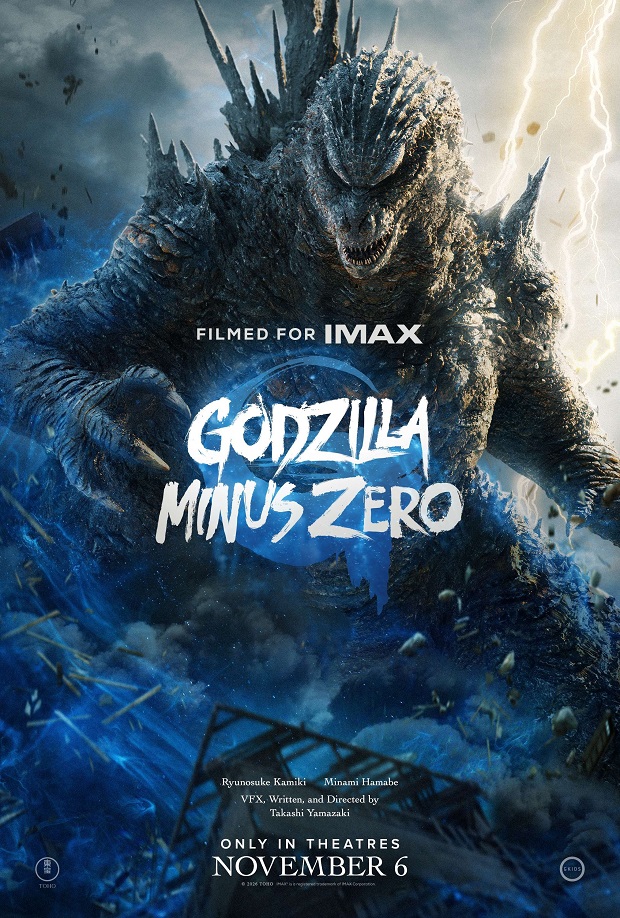
 Godzilla Minus Zero (2026) Toho/Sci-Fi-Horror RT: 135 minutes Rated R (some violent content/bloody images) Director: Takashi Yamazaki Screenplay: Takashi Yamazaki Music: Naoki Sato Cinematography: Kozo Shibasaki Release date: November 6, 2026 (US) Cast: Ryunosuke Kamiki, Minami Hamabe, Min Tanaka, Hidetaka Yoshioka, Masami Nagasawa, Yuki Yamada, Kuranosuke Sasaki, Jun Kunimura, Sakura Ando, Miou Tanaka, Sae Nagatani. Spoken in Japanese w/English subtitles
Rating: *** ½
There is a precise moment in a great monster movie when awe curdles into terror, and terror turns into something resembling religious dread. You aren’t watching a routine flex of digital processing power; you are watching an act of God. Or, at the very least, a creature doing a terrifyingly believable audition for the role.
When Takashi Yamazaki gave us Godzilla Minus One, he pulled off a trick that modern Hollywood blockbusters have largely forgotten: he made the ants underfoot matter. You actually cared whether Kōichi Shikishima lived to see tomorrow. When a building collapsed in his Tokyo, it wasn’t just visual noise to pad a third-act set piece- it was a human tragedy with dirt under its fingernails and ash in its throat.
Now comes Godzilla Minus Zero, a sequel that takes a dangerous, high-wire leap. Set in 1949, Japan is still a bruised, haunted nation trying to piece together a modest existence out of the radioactive fallout. Shikishima (Kamiki), looking ten years older and carrying the silent weight of a man who survived when he shouldn’t have, is trying to build a quiet domestic life with Noriko (Hamabe) and their adopted daughter Akiko (Nagatani). Their trauma isn’t written into dialogue; it’s carved directly into the tired lines around their eyes.
Then the ocean begins to boil.
On paper, introducing King Ghidorah- a three-headed golden dragon straight out of Showa-era fantasy-into a grief-stricken historical drama sounds like a fatal plunge into B-movie camp. But Yamazaki doesn’t treat Ghidorah like a cartoon villain. He treats him like a cosmic plague. When those golden wings unfurl over Ginza, blotting out the noon sun, the sequence feels less like a comic book panel and more like an eyewitness newsreel beamed back straight from hell.
And Godzilla? He hasn’t returned as a savior or an anti-hero. He remains what he was always meant to be: a walking atomic bomb, an engine of pure, indiscriminate spite. When these two leviathans collide on the screen, the weight of the CGI is genuinely staggering. You don’t just see the blows; you feel the air pressure drop. You can practically smell the ozone and scorching steel bleeding through the theater projection.
If the film falters, it’s because Yamazaki occasionally lets the scale get away from him. Minus One succeeded because it was a tight, desperate chamber piece set against a giant shadow. Here, squeezed between secret military tribunals, rogue kaiju research teams, and sprawling subplots, the core human story occasionally gets elbowed out of its own picture. We want more quiet moments with Shikishima and Noriko, but the film is often too eager to rush back to the war room map.
Yet when the dust settles and the sirens blare, the film remembers its soul. The true heroism here doesn’t belong to super-weapons or grand military strategists, but to the everyday survivors- the battered boat captains, the engineers, the meteorologists- who stand in the shadow of giants with nothing left to fight with except their refusal to die.
Returning actors like Hidetaka Yoshioka (as the resourceful scientist Kenji “Doc” Noda) and Kuranosuke Sasaki deliver grounded performances as ordinary citizens. The ensemble highlights humanity’s vulnerability and collective resolve when facing catastrophic threats. Kamiki plays Kōichi with a weary, lingering intensity. Rather than portraying a typical action hero, his performance focuses on the post-war psychological weight of a man trying to rebuild a peaceful life for his family while dealing with lingering trauma. Hamabe provides the film’s emotional center. Her portrayal shifts Noriko from a survivor into a driving force of compassion, balancing her commitment to her family with a sense of duty to help her community endure the rising chaos.
The visual effects for Godzilla Minus Zero are overseen directly by director Takashi Yamazaki and his team at Shirogumi Inc. Following their Oscar-winning work on Godzilla Minus One, the VFX production takes a massive leap in technical scale, visual fidelity, and cinematic presentation. Working with a larger production budget than Minus One, Yamazaki expanded the VFX pipeline at Shirogumi. This allowed for far denser particle simulations- such as water displacement, collapsing concrete, and localized weather anomalies generated during kaiju encounters.
Rendering multi-kaiju battles required complex physics modeling. The team developed custom digital lighting shaders to accurately capture the glow of Godzilla’s atomic energy contrasting against King Ghidorah’s golden scale reflections and energy bursts. While heavily reliant on state-of-the-art CG modeling, the production maintained its signature tactile feel by pairing digital monster rendering with practical set destruction, physical dust cannons, and miniature work during ground-level perspective shots.
I have sat through hundreds of creature features over the years. Most are content to let rubber suits or pixels do the heavy lifting while actors stare blankly at tennis balls on sticks. Godzilla Minus Zero belongs to that rare, exhilarated breed of cinema that demands grand visual spectacle without ever surrendering human dignity. It also offers the fun of Japanese kaiju films with some shameless overacting from Min Tanaka as the vengeful biologist still carrying scars from Hiroshima.
Godzilla Minus Zero may not hit the exact, piercing bullseye of its predecessor, but when those giant shadows fall across the screen, it delivers the real, honest-to-God article.