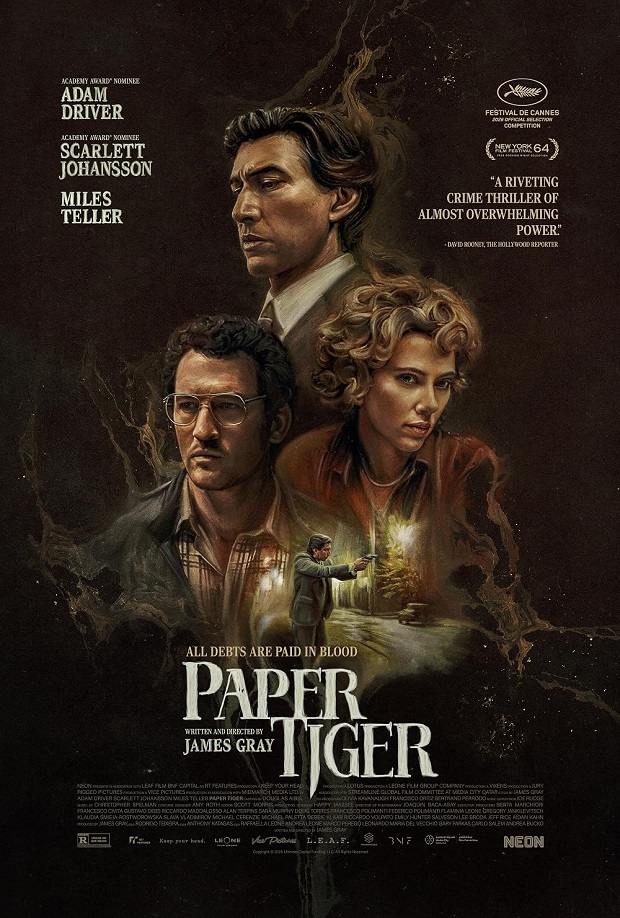
 Paper Tiger (2026) Neon/Drama-Crime-Thriller RT: 115 minutes Rated R (language and some violence) Director: James Gray Screenplay: James Gray Music: Christopher Spelman Cinematography: Joaquin Baca-Asay Release date: November 13, 2026 (US) Cast: Adam Driver, Scarlett Johansson, Miles Teller, Gavin Goudey, Roman Engel, Victor Ptak, Cindy Katz, Yavor Vesselinov, Joel Marsh Garland.
Rating: **
There is a distinct kind of frustration that comes from watching a prestige crime drama put all of its heavy pieces on the board, only to spend two hours shuffling them back and forth without ever making a decisive move. James Gray’s Paper Tiger sets its sights on the gritty, asphalt-stained streets of 1986 New York, pulling together an elite trio of actors for what promises to be a tense, high-stakes collision with the Russian mob. Yet for all its brooding atmosphere and earnest dramatic posturing, the film ultimately just spins its wheels, going through the routine motions of urban corruption before fizzling out entirely.
Gray is a filmmaker whose best work- masterpieces of tragic urban fatalism like Little Odessa, The Yards, We Own the Night, and The Immigrant- succeeds precisely because he knows how to balance patient, atmospheric storytelling with a deep, crushing sense of moral fallout. In those earlier pictures, Gray understood how to build pressure until the frame felt heavy with unspoken stakes, anchoring genre mechanics in raw, bruising family emotion and a palpable sense of place. With Paper Tiger, however, that signature patience curdles into static repetition. Instead of tightening the vice the way he handled familial doom in The Yards or We Own the Night, Gray lets the narrative just sit there, trading the grand, tragic scope of his superior previous credits for a hollow exercise in mood that goes nowhere.
The setup is familiar neo-noir boilerplate: two brothers- NY cop Gary (Driver, Marriage Story) and engineer Irwin (Teller, Top Gun: maverick)- stumble into a lucrative business proposition near the Gowanus Canal that turns out to be tied to organized crime, putting Irwin’s family in the crosshairs and forcing Driver’s character into impossible corners. But instead of tightening the vise, Gray’s script gets bogged down in repetitive domestic anxieties and muddled subplots.
For long stretches, the narrative simply idles in neutral. Much of the dead weight falls squarely on Teller’s character- a painfully naive, profoundly self-centered portrait of suburban complacency. Following a terrifying car accident that directly threatens his family, Teller’s character retreats so deeply into his own financial panic that it seemingly never even occurs to him to turn around and ask his wife Hester (Johansson, Marriage Story) how she is holding up. You find yourself staring at the screen wondering: does he even care about her at all, or is she just another prop in his desperate hustle?
This emotional detachment bleeds into the rest of the cast. Even the presence of Johansson as the anxious partner raising the alarm feels underutilized, reduced to cycling through variations of worry while waiting for a narrative spark that never quite catches fire. Her health crisis subplot just feels superfluous. Gray fails to integrate it into the plot in a meaningful or significant way. It’s basically filler in a movie that doesn’t need any. The basic premise of sibling loyalty tested by involvement with organized crime has made for some great movies in the past.
Joaquin Baca-Asay’s cinematography captures the grit of mid-80s New York with a muted, asphalt-stained palette that feels lived-in and authentic, yet the lens often lingers too long on brooding empty spaces rather than driving the drama forward. That visual stagnation is mirrored in Christopher Spelman’s score, which leans heavily into low-register synth drones and brooding ambient cues that try to manufacture a tense atmosphere out of thin air, ultimately sounding more like a repetitive exercise in mood than a living, breathing musical accompaniment.
The real casualty of this structural drift is the climax- or lack thereof. Just as the tension should be snapping taut, the film simply meanders toward an abrupt, deflating fade-out that offers no real closure or emotional payoff for all the turbulence preceding it. Characters drift off, loose ends flap uselessly in the wind, and the credits drop with a resounding thud, leaving you stranded with a series of unresolved setups.
Driver and Teller give it their professional best, bringing a grounded, blue-collar weariness to their roles, but they can’t engineer momentum out of a stalled machine. Paper Tiger has all the outward aesthetic trappings of a classic New York crime saga, but beneath the hood, the engine is completely hollow. It’s a crushing disappointment from a gifted filmmaker operating within his wheelhouse.