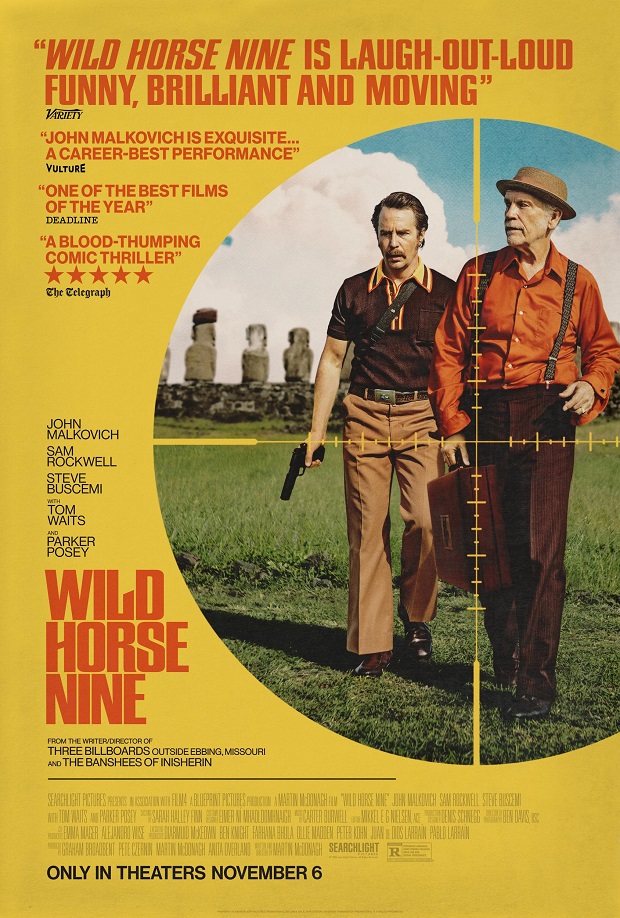
 Wild Horse Nine (2026) Searchlight/Comedy-Thriller RT: 118 minutes Rated R (pervasive language, some strong violence, drug use, and sexual references) Director: Martin McDonagh Screenplay: Martin McDonagh Music: Carter Burwell Cinematography: Ben Davis Release date: November 6, 2026 (US) Cast: John Malkovich, Sam Rockwell, Steve Buscemi, Tom Waits, Parker Posey, Mariana di Girolamo, Ailín Salas, Paola Giannini.
Rating: ***
Martin McDonagh has built one of the most distinctive careers in modern cinema by dropping deeply flawed, endlessly talkative men into remote corners of the globe and letting them talk themselves into moral corners. Across modern classics like In Bruges, Three Billboards Outside Ebbing, Missouri, and The Banshees of Inisherin, McDonagh perfected a signature style that fuses razor-sharp, profane banter with sudden bursts of shocking violence and a pervasive, existential melancholy. With Wild Horse Nine, the writer-director shifts his gaze to 1973 Easter Island, delivering an atmospheric, wry, and deliberately meandering character piece. It is a film rich in verbal texture and lived-in performances—one I admired and thoroughly liked, even if its unhurried, wandering structure kept me from loving it unconditionally.
The story begins in Chile in September 1973, right on the tense, unstable eve of Augusto Pinochet’s military coup. Amid the gathering political storm, we meet a pair of shadowy American operatives—or whatever murky designation best describes men whose off-the-books assignments blur the line between intelligence work and criminal errands—played by John Malkovich (In the Line of Fire) and Sam Rockwell (Three Billboards Outside Ebbing, Missouri). Before long, a mission goes sideways, propelling the duo away from the mainland and across the Pacific toward the windswept isolation of Rapa Nui, better known as Easter Island.
True to McDonagh’s sensibilities, Wild Horse Nine is decidedly leisurely paced. Rather than barreling forward like a conventional espionage thriller, the narrative takes a distinctly circuitous route to reach its final destination. Conversations drift into tangential philosophical debates; detours pile upon detours; and looming over the entire journey is the tantalizing, half-whispered suggestion that Malkovich’s weary, enigmatic operative was somehow tangled up in the John F. Kennedy assassination a decade earlier. McDonagh treats that historical bombshell not as a pulse-pounding conspiracy clue, but as just another heavy, unspoken ghost rattling around inside a man who has already seen far too much.
For stretches, this unhurried wandering tests your patience—you can feel the story circling the runway long before it decides to touch down. Yet whenever the plot threatens to stall, the acting pulls you right back into the frame. The great chemistry between Malkovich and Rockwell is the indisputable engine of the picture. Rockwell, a longtime McDonagh collaborator who always knows how to locate the wounded vulnerability beneath a fast-talking exterior, plays his role with twitchy, restless energy. Malkovich counters him with dry, measured authority, rolling his syllables with that unmistakable, hypnotic cadence that turns even a throwaway remark into an event. Together, they bicker, needle, and confide in one another like an old married couple trapped in a geopolitical purgatory.
Just as memorable is Steve Buscemi (a busy man as of late), who turns in a great performance in a key supporting role. Buscemi brings a bruised, soulful weariness to the screen as the enigmatic CIA leader MJ, capturing the quiet desperation of a man caught between institutional loyalty and personal conscience. In a cast full of seasoned scene-stealers, he grounds the film’s more eccentric impulses in genuine human ache.
Despite appearing exclusively over the phone as Marge, the estranged wife Sam Rockwell’s Lee leaves behind in the United States, Parker Posey (Best in Show) makes a remarkably vivid impression with minimal screen time. Delivering her lines in razor-sharp, venomous bursts—most memorably firing back a deadpan “Who cares?!” when Lee half-heartedly asks about their kids—Posey injects the film with a burst of caustic dark humor. In just a handful of terse phone exchanges, she effortlessly sketches out a marriage on the verge of collapse, giving Lee’s overseas drift a grounded, domestic sting without ever setting foot on the island.
All three actors feast on McDonagh’s dialogue, which remains as musical, profane, and darkly funny as ever. The film’s dark humor doesn’t arrive via broad slapstick, but through the absurd contrast between grand historical turmoil and petty human stubbornness. Characters debate semantics, loyalty, and old grudges while regimes topple in the background, finding bleak comedy in the realization that even at the end of the world, men still carry their same small vanities in their luggage.
Visually, the picture looks remarkable. The cinematography—shot on location amid rugged coastlines and towering Moai statues—eschews modern digital gloss in favor of muted earth tones, overcast skies, and grainy, natural textures. The aesthetic is strongly reminiscent of a bleak, melancholic drama of the 1970s—think the paranoid, existential mood of The Parallax View crossed with the dusty, existential drift of The Parallax View. Every frame feels steeped in dread and solitude.
The soundtrack complements that brooding atmosphere with sparse, haunting acoustic passages and period needle drops, though one musical choice raises a glaring historical eyebrow: the inclusion of Diana Ross’s “Theme from Mahogany (Do You Know Where You’re Going To).” While the song’s wistful melody fits the characters’ aimless drifting, its presence in a 1973-set film is an obvious anachronism, given that the track wasn’t released until 1975. Whether an intentional poetic flourish or a simple oversight, it momentarily pulls you out of the otherwise meticulous period illusion.
In the end, Wild Horse Nine feels like a minor-key entry in McDonagh’s filmography—less tightly wound than In Bruges and less emotionally devastating than The Banshees of Inisherin. Its circuitous plotting leaves a few too many threads dangling in the Pacific breeze. Still, watching Malkovich, Rockwell, and Buscemi trade barbs against a haunting 1970s backdrop is a pleasure in its own right. I liked the journey considerably, even if I wished the destination carried a sharper punch.