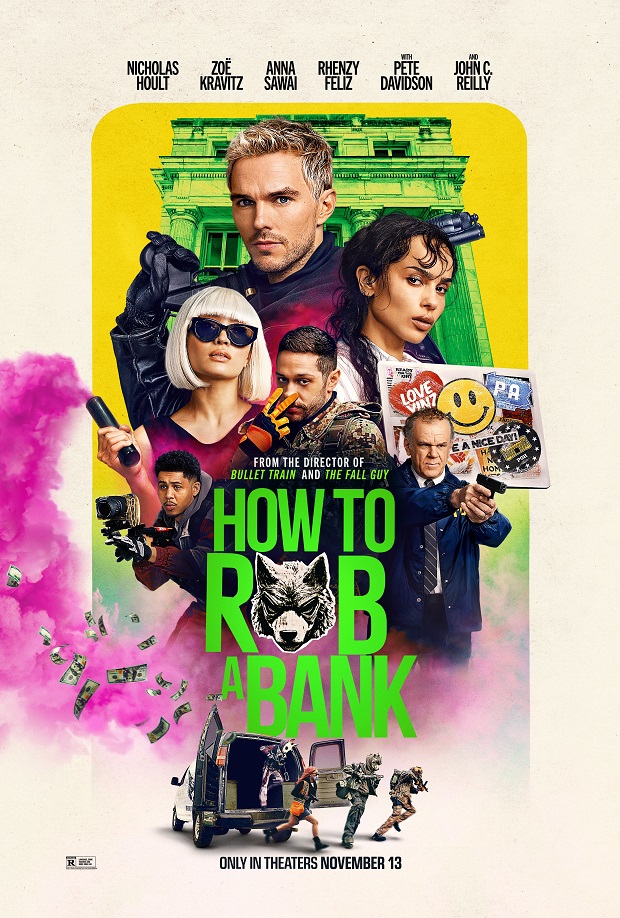
 How to Rob a Bank (2026) Amazon-MGM/Action-Thriller RT: 122 minutes Rated R (language, violence, brief drug use) Director: David Leitch Screenplay: Mark Bianculli Music: Dominic Lewis Cinematography: Jonathan Sela Release Date: November 13, 2026 (US) Cast: Nicholas Hoult, Zoë Kravitz, Anna Sawai, Rhenzy Feliz, Pete Davidson, John C. Reilly, Christian Slater, Tati Gabrielle, Paul Sparks, Young Mazino, Andrew Schulz, Alessandra Frugoli.
Rating: ***
Few filmmakers working today understand the sheer kinetic joy of forward momentum quite like David Leitch. Having thoroughly proven his action movie mettle with Atomic Blonde, Fast & Furious Presents: Hobbs & Shaw, Bullet Train, and The Fall Guy, Leitch brings his signature stunt-coordinator precision to How to Rob a Bank, a loud, energetic, and slickly packaged crime caper that wants to be both a populist protest anthem and a glossy popcorn thrill ride. It doesn’t always reconcile those two competing impulses, yet even when the story wobbles, the sheer craftsmanship on display keeps the wheels turning fast enough to deliver a solid good time.
Set in Pittsburgh, the film draws much of its attitude from the friction between working-class pride and institutional power. Mark Bianculli’s screenplay positions its central crew as modern-day outlaws committing audacious daylight crimes against the white-collar establishment in a proudly blue-collar city. Beneath the getaway cars and tactical gear lies pointed societal commentary on corporate greed and an inequitable, unaffordable healthcare system that routinely leaves ordinary citizens financially ruined. Rather than simply stuffing cash into duffel bags and vanishing, the robbers turn their heists into viral spectacles, streaming their exploits to a public all too eager to cheer anyone sticking it to the financial elite.
From the opening frame, Leitch refuses to let the camera sit still. The lens is always in motion—sweeping through marble-floored bank lobbies, weaving through Pittsburgh’s steel bridges and tight neighborhood streets, and plunging right into the passenger seat during high-speed escapes. Cinematographer Jonathan Sela and editor Elísabet Ronaldsdóttir work in tight synchronization to maintain an adrenalized pulse, cutting briskly between chaotic on-the-ground action, surveillance feeds, and slick social-media overlays. The film’s color scheme reinforces that thematic divide, pairing the weathered, steel-gray industrial tones of working-class Pittsburgh against sharp, saturated bursts of neon, cool blues, and sterile metallic surfaces inside the corporate towers and digital command centers.
Anchoring the heist crew is Nicholas Hoult (Superman) as Ryan, the charismatic mastermind known online as “The Wolf.” Hoult plays him with an easy, nimble charm—less a hardened career criminal than an idealistic showman who realizes that in the digital age, controlling the narrative is half the job. Opposite him on the investigative side is Zoë Kravitz (The Batman) as Reagan Gardner, a sharp-witted hacker and former Carnegie Mellon professor recruited to help federal authorities decode the crew’s digital trail. Kravitz brings a cool, observant intelligence to the role, grounding the film’s flashier mechanics whenever she is onscreen.
Rounding out the law-enforcement side of the equation is John C. Reilly (Boogie Nights) as FBI Agent John West, the seasoned investigator tasked with bringing the crew down. Reilly is effortlessly engaging, playing West with a rumpled, dryly humorous weariness that gives the pursuit a welcome human pulse. Instead of a stiff, procedural bureaucrat, Reilly’s West feels like an experienced civil servant trying to outmaneuver criminals playing by an entirely different set of rules.
Every populist caper needs a worthy target, and Christian Slater (Heathers) is great as the bad guy. Cast as David Walton, a smug, greedy bank president who takes open pride in granting predatory loans he knows borrowers will never be able to pay back, Slater devours every scene with silky, unrepentant relish. He plays corporate villainy without an ounce of apology, giving the audience a clear, hissable embodiment of the systemic rot the robbers claim to be fighting.
Where How to Rob a Bank runs into trouble is its persistent habit of choosing style over substance. For all its righteous anger about predatory banking and broken healthcare, Mark Bianculli’s script rarely pushes past broad talking points, treating serious economic pain more as stylish window dressing than deeply felt drama. Worse, the movie suffers from a noticeably disjointed narrative. Juggling the heist crew’s internal dynamics (including supporting turns from Anna Sawai, Rhenzy Feliz, and Pete Davidson), the FBI’s cat-and-mouse chase, and Walton’s boardroom machinations, the film frequently lurches between broad comedic banter and earnest class-warfare melodrama without ever fully smoothing out the gears.
Even so, Leitch’s command of pace, framing, and ensemble chemistry goes a long way toward smoothing over the structural bumps. How to Rob a Bank may be a bit scattered beneath its glossy exterior, and its social critique doesn’t cut nearly as deep as it thinks it does, yet as a brisk, rebellious piece of big-screen entertainment, it comfortably earns its keep.