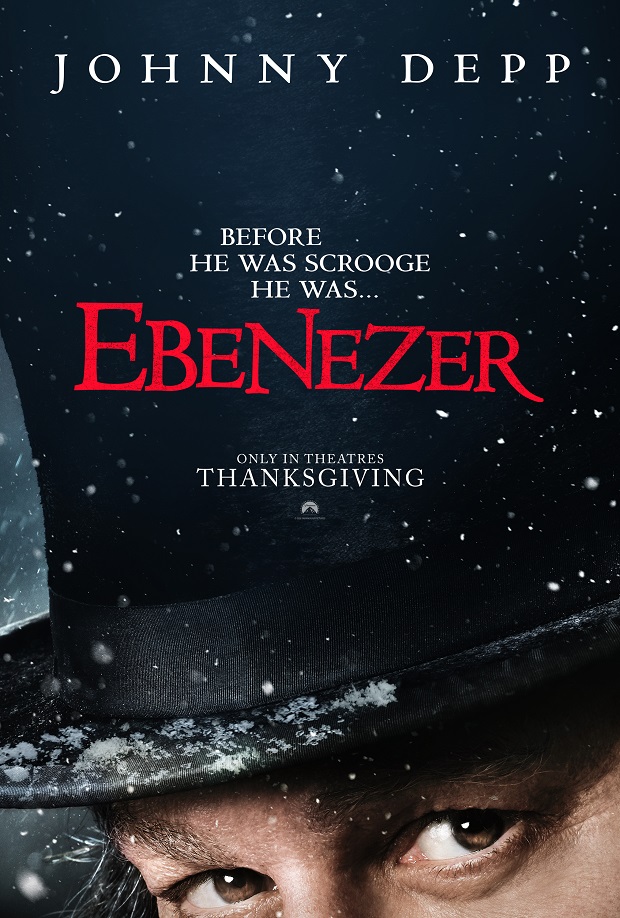
 Ebenezer (2026) Paramount/Drama-Fantasy RT: 116 minutes Rated PG-13 (frightening material) Director: Ti West Screenplay: Nathaniel Halpern Music: Tyler Bates Cinematography: Checco Varese Release date: November 13, 2026 (US) Cast: Johnny Depp, Rupert Grint, Andrea Riseborough, Tramell Tillman, Robert Strange, Sam Claflin, Daisy Ridley, Ian McKellen, Arthur Conti, Ellie Bamber, Henry Lloyd-Hughes, Charlie Murphy, Freddie Lee-Grey, Alfie Buck, Rose Williams, Richard McCabe, Michael Culkin, Claire Higgins, Franc Ashman, Sara Galvin, Zac Wishart, Eva Wishart, Scott Reid, Trevor Laird.
Rating: ***
Charles Dickens’s A Christmas Carol is practically an indestructible piece of storytelling machinery. Over the decades, the 1843 novella has been reshaped into everything from broad satirical farce to animated family musicals and somber Victorian ghost stories, and yet its central moral engine keeps right on humming. With Ebenezer, filmmaker Ti West—best known for his sharp, retro-styled horror work (the X trilogy)—steps into the snowy, cobblestone streets of 19th century London to deliver a decent, richly textured adaptation that leans hard into the supernatural chill at the heart of Dickens’s text.
Despite what the studio’s marketing campaign and trailers might lead you to believe, Ebenezer is not exactly a comedy. Where promotional spots have tried to sell the picture on quirky eccentricities and broad seasonal laughs, the finished film takes itself noticeably more seriously than the versions starring Bill Murray, Jim Carrey, or The Muppets. West treats the material first and foremost as a genuine ghost story. The result is spooky, atmospheric, and period-perfect, soaking every foggy alleyway and drafty counting-house in a rich gothic aesthetic that plays almost like a classic Hammer horror film. Shadows stretch long across worn floorboards, candlelight flickers against frost-rimed glass, and the spectral visitations carry a tangible sense of dread alongside their moral urgency.
To ground that classic structure, West even uses onscreen text to introduce each of the five staves, directly mirroring the original chapter divisions of Dickens’s 1843 novella. It is a smart, literary framing device that gives the narrative a deliberate, storybook cadence while reminding the audience that A Christmas Carol was always intended to be read—and experienced—as a haunting in five distinct movements.
Of course, the main marquee draw here is Johnny Depp, marking a high-profile theatrical comeback in the title role. It is genuinely nice to see Depp back in action on the big screen, and from his very first scowl, it is obvious he is thoroughly enjoying himself. The trouble is that sometimes he enjoys himself a little too much. While Depp captures the physical frailty and bitter isolation of Ebenezer Scrooge, he frequently indulges in too much mugging—leaning into exaggerated facial contortions, theatrical double-takes, and eccentric vocal tics that threaten to pull the character out of Dickens’s grounded reality and back toward his familiar gallery of quirky outsiders.
That impulse toward self-referential winkery hits an especially jarring note during a sequence that includes a blatant nod to Depp’s feature debut role in A Nightmare on Elm Street. Clever as it might look on paper to horror fans, the reference feels entirely out of place here. Rather than enhancing the spookiness, it shatters the Victorian spell and actively undermines the emotional truth of a miserly, miserable man’s hard-won redemption.
Fortunately, West surrounds his leading man with an exceptional ensemble that keeps the drama anchored whenever Scrooge starts chewing the scenery. Rupert Grint (Harry Potter) is quietly effective and deeply sympathetic as Bob Cratchit, bringing a worn-down dignity and genuine warmth to the underpaid clerk without turning him into a passive saint. Ian McKellen (The Lord of the Rings) is, unsurprisingly, great and wonderfully distinguished, lending his unmistakable vocal authority and classical gravitas to the proceedings in a way that elevates every scene he inhabits.
Even better are the spectral guides who steer Scrooge through his long night of reckoning. Andrea Riseborough (Mandy) and Tramell Tillman (Spider-Man: Brand New Day) just about steal the show as the Ghosts of Christmas Past and Christmas Present, respectively. Riseborough brings an eerie, ethereal intensity to Christmas Past—both fragile and piercing, like a memory that refuses to stay buried. Tillman, meanwhile, commands the screen as Christmas Present, radiating booming charisma and theatrical force while never losing sight of the underlying sorrow and warning beneath his festive exterior. Together, they provide the film with its sharpest dramatic sparks.
On a technical level, Ebenezer is consistently impressive. The special effects work is crisp, imaginative, and seamlessly integrated into the practical period sets, allowing the supernatural transitions through time and space to feel tactile rather than overly digital. When Scrooge is swept above the rooftops of London or confronted by the grim realities of the future, the visual craft carries real weight.
Ultimately, Ebenezer doesn’t quite supplant the very best screen versions of Dickens’s immortal tale, largely because Depp’s performance never fully decides whether it wants to inhabit Scrooge or comment on him. Yet thanks to Ti West’s atmospheric direction, Hammer-inspired gothic flair, and standout turns from Riseborough, Tillman, McKellen, and Grint, it remains a handsome, haunting, and thoroughly watchable holiday ghost story.