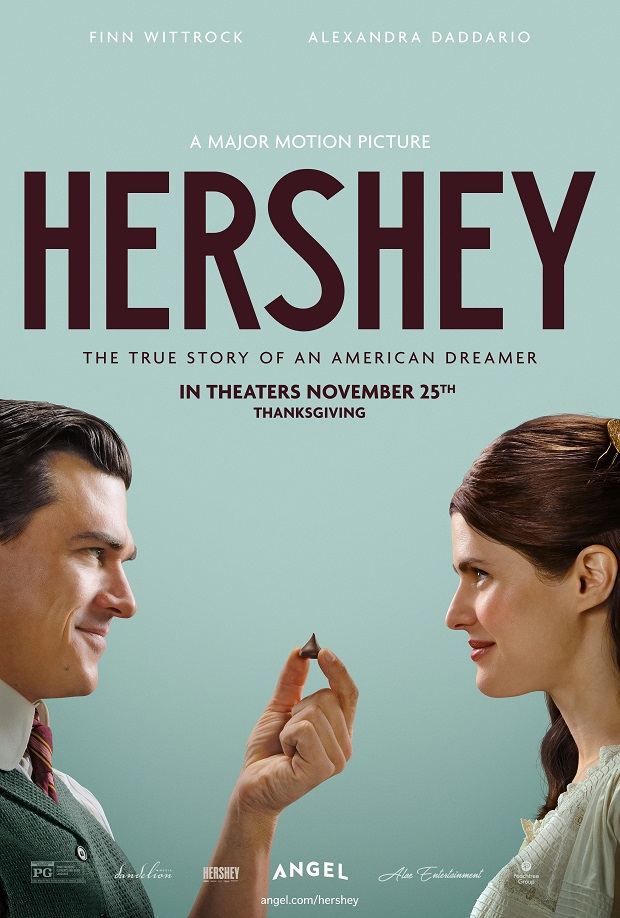
 Hershey (2026) Angel/Drama RT: 107 minutes Rated PG (some thematic elements and brief language) Director: Mark Waters Screenplay: T.M. Hayes and Sharon Paul Music: Rolfe Kent Cinematography: Ed Wu Release Date: November 25, 2026 (US) Cast: Finn Wittrock, Alexandra Daddario, Alan Ruck, Richard Kind, David Costabile, Heléne Yorke, James Kelly, Francesca Faridany, Dina Spybey-Waters, John Hans Tester, Michael Moreland Milligan, Joel Brady, Daniel David Stewart, Jobie James, Isabel Van Natta, Braxton McCollum, Harrison Salvi.
Rating: ***
There is an inherent, almost nostalgic comfort in watching the origin story of an American institution that practically everyone on earth has unwrapped at least once. Mark Waters’ (Mean Girls) Hershey is a pleasant, earnestly crafted biographical drama that traces the improbable rise of Milton S. Hershey, the visionary Pennsylvania candymaker who cracked the industrial code on mass-producing and affordably distributing milk chocolate across the United States. Built around a genuinely fascinating real-life narrative and anchored by an engaging, warm-hearted cast, the film goes down smoothly—even if its steadfast refusal to dig beneath a glossy, sanitized surface leaves the finished product tasting distinctly vanilla.
The storyline follows Milton Hershey (Wittrock, Unbroken) from his early, bankruptcy-strewn days as a restless young entrepreneur in Philadelphia and Lancaster to the creation of his utopian company town and sprawling chocolate empire in rural Derry Township. Rather than focusing solely on dairy formulas, caramel batches, and assembly-line breakthroughs, Sharon Paul and Timothy Michael Hayes’s screenplay divides its attention between Hershey’s commercial triumphs, his landmark philanthropic legacy—most notably the founding of the Milton Hershey School for orphaned and disadvantaged children—and the intimate personal relationships that shaped his worldview from boyhood onward.
At the emotional core of his private life are two defining anchors that give the story its strongest human pulse. The first is his complicated, fiercely protective relationship with his mother, Fanny (Faridany, Manifest). A devout, pragmatic Mennonite woman who loves her son deeply yet carries the scars of repeated financial instability, Fanny remains terrified that Milton will turn out to be a chronically unreliable dreamer just like his father, Henry (Ruck, Ferris Bueller’s Day Off), a charming, restless wanderer who walked out on the family when Milton was just a child. The dynamic between mother and son provides the film with its most grounded friction, capturing the quiet tug-of-war between hard-earned caution and stubborn, against-the-odds ambition.
The second anchor is Milton’s deeply devoted marriage to Catherine “Kitty” Sweeney (Daddario, San Andreas), a lively, independent-minded woman from New York, whose whirlwind courtship with Milton injects the middle stretch of the picture with genuine warmth and romantic spark. For a time, Kitty serves as Milton’s sharpest sounding board and happiest companion—until their domestic bliss is shadowed by the onset of a progressive, debilitating neurological illness that gradually strips away her mobility and independence, testing the boundaries of their partnership.
In terms of visual craft, Hershey does an admirable job recreating the look, feel, and physical texture of the late 19th and early 20th centuries. Shot largely on location in Pennsylvania, the production design and cinematography capture the era with handsome, storybook warmth—from gaslit small-town storefronts, bustling brick avenues, and horse-drawn carriages to the clattering, copper-kettle factory floors where Milton endlessly experiments with fresh milk and cocoa beans. The costumes, period interiors, and seasonal landscapes feel lived-in and authentic without drawing excessive attention to themselves, giving the movie the inviting sheen of a classic prestige historical drama.
Where the film consistently stumbles is in its weak script, which favors inspirational platitudes and neat dramatic resolutions over genuine psychological or historical friction. True to standard operating procedure for distributor Angel Studios, Hershey practically canonizes its protagonist, portraying Milton as a near-saint whose every business failure is merely a providential stepping stone toward benevolent greatness. The screenplay has almost nothing critical to say about its subject—save for a recurring, somewhat predictable dramatic beat in which Milton becomes so consumed by his grand industrial and civic ambitions that he remains painfully oblivious to his wife’s worsening health until crisis forces him to slow down.
Meanwhile, the grittier historical realities of Gilded Age and Progressive Era capitalism are neatly swept under the rug. Complex, real-world issues—such as labor disputes, the rigid social paternalism inherent in corporate-owned company towns, and the harsh factory conditions of the era—are sidestepped entirely so that nothing disturbs the uplifting, family-friendly mood. By smoothing away every sharp corner of the historical record, the movie reduces a towering, complicated industrialist to a gentle folk hero.
Fortunately, the acting frequently elevates the material well above its Hallmark-adjacent writing. Wittrock does a fine, charismatic job as Hershey, projecting an infectious, relentless optimism paired with a quiet, boyish vulnerability that makes you root for him even when the script refuses to challenge him. Daddario brings grace, intelligence, and genuine emotional weight to Kitty, navigating her character’s physical decline with admirable restraint and dignity rather than cheap melodrama.
The supporting players add welcome texture and personality throughout. Alan Ruck brings a wistful, disarming flakiness to Milton’s absentee father, making it easy to understand both why young Milton inherited his boundless imagination and why Fanny resented every ounce of it. Faridany plays Fanny with sharp, unsentimental intelligence, grounding every scene she shares with Wittrock in authentic maternal concern. Best of all is a delightful appearance by Richard Kind (Curb Your Enthusiasm) as Joseph Royer, the seasoned Lancaster candymaking mentor who first opens the door to the confectionery trade for young Milton. Kind brings his trademark warmth, dry humor, and lived-in decency to the role, giving the early chapters a much-needed jolt of character-driven charm.
Ultimately, Hershey is far too polite and hagiographic to stand alongside the finest American biographical dramas. By sanding down the rougher edges of its subject and his era, it settles for comfort over complexity, offering an idealized portrait rather than a fully dimensional one. Yet thanks to an inherently compelling American success story, handsome period recreation, and sincere, likable performances from Wittrock and his ensemble, it remains a sweet, watchable, if decidedly safe, crowd-pleaser.