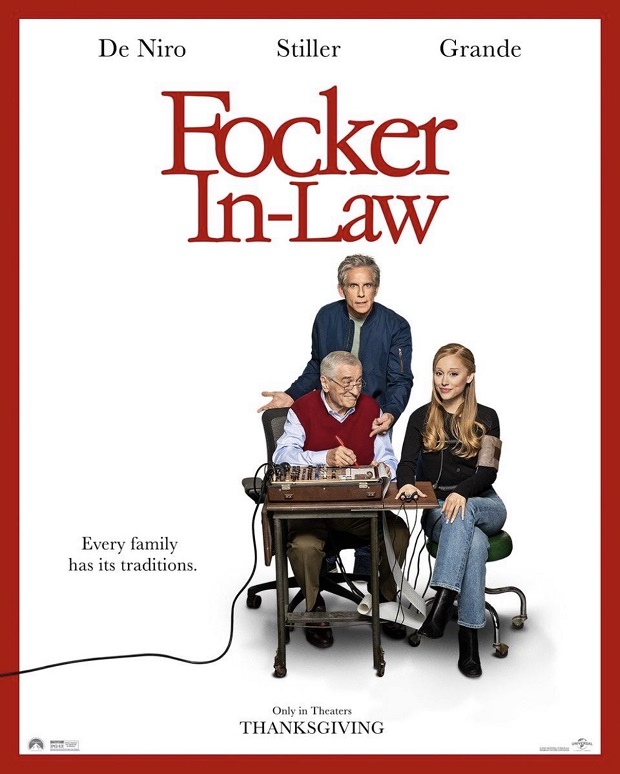
 Focker-in-Law (2026) Universal/Comedy RT: 105 minutes Rated PG-13 (strong language and suggestive references) Director: John Hamburg Screenplay: John Hamburg Music: Theodore Shapiro Cinematography: Barry Peterson Release Date: November 25, 2026 (US) Cast: Robert De Niro, Ben Stiller, Ariana Grande, Owen Wilson, Blythe Danner, Teri Polo, Skyler Gisondo, Beanie Feldstein, Eduardo Franco, Cole Escola.
Rating: *
I want a Focking divorce from this family!
Twenty-six years after Meet the Parents turned domestic anxiety into box-office gold—and sixteen years after Little Fockers seemed to bury the premise under a mountain of strained farce—Universal has exhumed the clan once again for Focker-in-Law. Written and directed by longtime franchise co-writer John Hamburg (Along Came Polly), this fourth installment arrives with the weary, mechanical energy of a family obligation nobody particularly wanted to attend. To put it plainly, the movie is painfully unfunny. Across a sluggish 105 minutes, not a single frame is even remotely amusing, leaving the audience trapped in an unwatchable slog of stale sitcom misunderstandings and exhausted comic tropes.
The plot gathers the extended clan—the Fockers and the Byrneses—together to celebrate patriarch Jack Byrnes’s (De Niro, Goodfellas) 80th birthday. The gathering also serves as an occasion to meet Olivia Jones (Grande, Wicked), the strong-willed new girlfriend of Greg and Pam’s now-grown son, Henry (Gisondo, Booksmart), who plans to propose during the weekend. Naturally, Greg (Stiller, There’s Something About Mary) immediately spirals, convinced that Olivia is completely wrong for the sensitive son he still coddles way too much. Complicating matters—or at least attempting to manufacture a plot—is the fact that Jack unexpectedly approves of Olivia, flipping the franchise’s old dynamic on its head as Greg plays the suspicious gatekeeper trying to expose his son’s fiancée-to-be.
On paper, turning Greg Focker into the paranoid, overprotective father-in-law he once feared might sound like a neat symmetrical hook. In execution, Hamburg’s screenplay (developed from a story with Ilana Glazer and Austen Earl) has zero interest in fresh comic observation. Instead, it trots out a parade of dusty, recycled gags involving lie detectors, dysfunctional pets, and disaster-laden air travel that felt tired two decades ago. Once again, the vast majority of the humor boils down to Stiller being publicly humiliated or somehow embarrassing himself in front of polite company, whether through clumsy physical mishaps, misconstrued comments, or escalating social mortification. Comedy built on second-hand embarrassment requires sharp timing and genuine human stakes to land; here, it simply feels punitive and repetitive.
The pacing and cinematography (courtesy of Barry Peterson) possess all the visual distinction of a mid-tier network television pilot, flatly lit and edited without comic snap. Scenes drag on long after the punchline has telegraphed itself, relying on mugging reaction shots and forced double entendres to fill the dead air.
Even a talented ensemble cannot salvage material this inert. Stiller does his usual shtick—wide-eyed panic, stammering over-explanations, and frantic damage control—on pure muscle memory, hitting every familiar note without finding an ounce of new life in the character. Frankly, it hasn’t been funny since before the first movie. Beside him, De Niro largely phones it in, recycling his trademark squinting glare and clipped “circle of trust” cadence with the enthusiasm of a man counting the minutes until lunch. Blythe Danner (The Prince of Tides), returning as matriarch Dina Byrnes, is given terribly limited screen time, practically relegated to background decoration while the louder, cruder set pieces play out around her. Returning as Pam, Teri Polo (The Fosters) is given virtually nothing to do here, her character rendered all but useless as the script sidelines her into passive reactions while the surrounding farce spins out of control.
Among the younger generation, Gisondo looks consistently uncomfortable as Henry, stranded in a thankless role that asks him to act like an overgrown toddler enduring his father’s suffocating neuroses. Beanie Feldstein (Booksmart) fares somewhat better as Henry’s sister Samantha, bringing a welcome, grounded dryness to her scenes alongside Eduardo Franco (Stranger Things) as her boundary-impaired boyfriend, though the script gives her precious little to work with.
In fact, Ariana Grande is the only person onscreen who seems like she’s genuinely enjoying herself. Leaning into Olivia’s polished exterior and sharp-edged poise, Grande brings a bright, game energy to her scenes that briefly hints at a livelier, smarter movie—before the screenplay inevitably drags her back into the same tired farce.
Yes, Focker-in-Law is marginally—and only slightly—better than the execrable Little Fockers, mostly because it spares us a few of that film’s lowest-common-denominator excesses. That, however, is faint praise indeed. This fourth entry simply did not need to be made. What began in 2000 as a tightly wound, relatable comedy of manners has curdled into an unwatchable franchise zombie, proving that some family reunions are best skipped altogether.