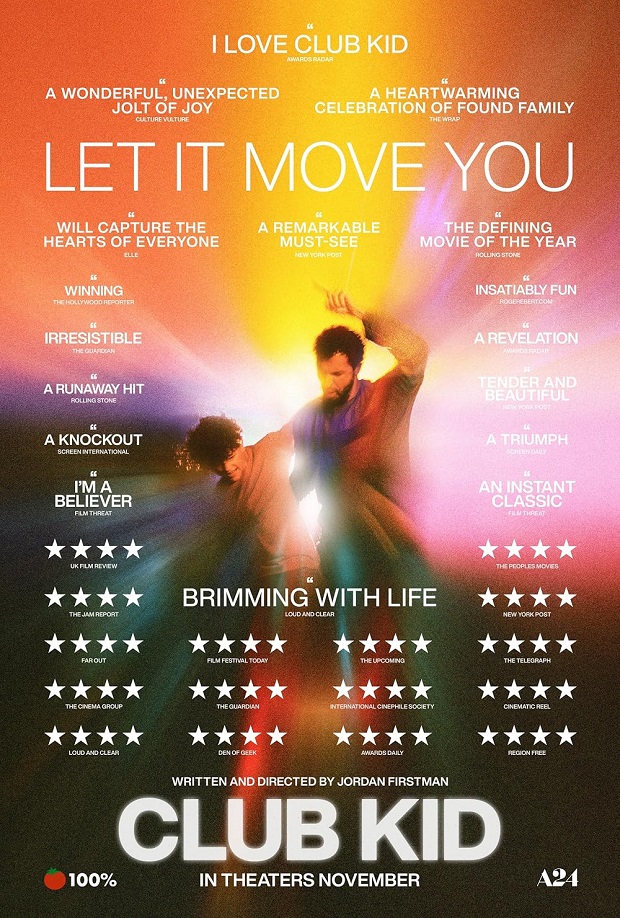
 Club Kid (2026) A24/Drama RT: 121 minutes Rated R (drug content throughout, strong sexual content, brief graphic nudity, and language throughout) Director: Jordan Firstman Screenplay: Jordan Firstman Music: Cristobal Tapia de Veer Cinematography: Adam Newport-Berra Release Date: November 6, 2026 (US, limited/US, wide) Cast: Jordan Firstman, Reggie Absolom, Cara Delevingne, Diego Calva, Kirby Howell-Baptiste, Colleen Camp, Vicki Pepperdine, Nigil Whyte, Eldar Isgandarov, Saturn Risin9, Miss Benny, Alaska Riley, Paris Petitjean, Jack Cameron Kay.
Rating: *** ½
Sudden-fatherhood comedies have a long, well-traveled history, and if you want a quick shorthand for Club Kid, think of it as the queer version of Big Daddy—minus Adam Sandler’s goofball antics. Where Sandler’s slacker coasted on broad slapstick and cartoon tantrums, Jordan Firstman’s feature film directorial debut anchors a remarkably similar premise in lived-in emotion, late-night vulnerability, and genuine heart.
Club Kid follows Peter (Firstman), a gay party promoter who must put his hedonistic lifestyle aside when he learns he has a 10YO son named Arlo (Absolom)—the result of a drug-induced threesome at a club—who suddenly needs him to step up after his mother’s suicide. It forces him to do something he’s put off for years: to grow up. What could easily have tilted into cheap irony or maudlin melodrama emerges instead as a surprisingly sweet and sad drama that successfully combines the late-night party scene with the reality of sudden fatherhood.
At the center of the story is Peter, a man whose entire identity has been built around guest lists, velvet ropes, basslines, and outrunning consequence. When tragedy strikes and Arlo enters his orbit, Peter’s carefully curated nightlife bubble starts cracking. Complicating matters is Sophie (model Delevingne), Peter’s vindictive ex-partner and a coked-up train wreck whose volatility threatens to turn a fragile transition into a full-blown crisis. As Peter tries to figure out how to be a steady presence for a grieving boy, he also begins a romance with Arlo’s social worker, Oscar (Calva, Babylon)—a relationship that challenges Peter to open himself up to real intimacy rather than fleeting nocturnal validation.
What makes the dynamic work so well is how refreshing Arlo is as a child character. The kid isn’t bratty or difficult; he’s a sweet boy who loves music and is completely open to the LGBTQ+ lifestyle. Rather than turning Arlo into a precocious wiseacre or an obstacle to be tamed, the film treats him as a perceptive, gentle kid trying to process profound loss while discovering his own rhythm—literally and figuratively—as an aspiring DJ. His scenes with Peter crackle with warmth and honesty, built on great chemistry between Firstman and Absolom that feels earned moment by moment rather than manufactured for laughs. Even Peter’s friends, accustomed to a world of fleeting thrills, gradually take a liking to Arlo, creating a surprising found-family texture around the edges.
By the third act, the stakes sharpen dramatically when the courts intervene as Arlo’s immigration status comes into question, turning an intimate emotional journey into an urgent legal and bureaucratic reckoning. Suddenly, late-night club scenes and DJ sets give way to sterile hallways, official scrutiny, and the terrifying prospect that good intentions alone won’t keep a newly formed family together. That tension culminates in a gripping courtroom scene featuring a deeply emotional speech by Peter—not a polished, theatrical monologue, but a raw, halting plea from a man who spent years running from responsibility and finally understands what it costs to stand by someone who needs him. It gives the third act genuine gravity without losing the film’s quiet humanity.
Firstman delivers a brilliant performance as Peter, peeling back the brittle armor of a party scene fixture to reveal someone terrified of failing at something that truly matters. Just like his character, Firstman is maturing onscreen and behind the camera, going from an Instagram comedian to a filmmaker to be reckoned with. There is zero smugness or viral-clip posturing here; Firstman understands rhythm, quiet pauses, and the exact weight of a look when words fall short. Delevingne sharpens the dramatic tension as Sophie, playing the spiral of addiction and resentment with raw, jagged edges that cut cleanly against the film’s softer emotional beats.
Technically, the movie feels deeply rooted in its setting. Shooting on film gives Club Kid a natural, tactile feel—subtle grain, organic skin tones, and a lived-in warmth that digital polish rarely captures. The cinematography makes great use of New York locations, moving effortlessly from gritty, pulsing clubs and cramped apartments to sunlit streets, courthouse corridors, and quiet corners of the city where grief lingers in the morning light. It is a raw and visceral piece of filmmaking, yet every emotion is earned, never pushed past what the characters have actually lived through.
Club Kid doesn’t gloss over the pain that brings its characters together, nor does it pretend that growing up happens overnight. By pairing the electric rush of New York nightlife with the quiet accountability of fatherhood—and anchoring the stretch run with real-world stakes—Firstman has crafted a very authentic film that hits hard without losing its soul. It’s a winner.